After a collision, your car needs more than cosmetic fixes. Proper restoration addresses structural damage, safety systems, and performance issues that determine how well your vehicle protects you in future accidents.
Many Riverside drivers wonder what actually happens during the repair process. Understanding each step helps you choose a facility that prioritizes safety over shortcuts. Royal Collision is a collision repair shop in Riverside owned by a second-generation technician. We follow manufacturer procedures to restore every affected system to its original specifications.
We explain what professional restoration involves. You’ll learn how impact forces damage vehicles, why surface repairs fall short, and what complete restoration requires to keep you safe.
What Happens to Your Vehicle During a Collision
Collisions transfer massive energy through your car’s structure in milliseconds. This energy doesn’t vanish after impact. Instead, it travels through specific pathways designed to protect occupants while absorbing destructive forces.
How Impact Forces Affect Structural Components
Your vehicle’s frame absorbs initial impact energy during collisions. Crumple zones collapse in controlled patterns to gradually dissipate force. These components redirect energy away from the passenger compartment where you sit.
Frame rails, mounting points, and reinforcement structures all bear extreme stress during accidents. Mounting points for suspension and engine components can shift even during seemingly minor collisions. When these areas move out of position, your vehicle’s handling and safety features become compromised.
Key structural areas affected by collision forces:
- Frame rails and cross members
- Suspension attachment points
- Engine and transmission mounts
- Door and roof pillar reinforcements
- Energy-absorbing crumple zones
Why Collision Damage Often Hides Beneath Surfaces
Visual inspection reveals only obvious damage like dents and scratches. Beneath these visible signs, serious problems often hide from view. Frame rails bend without showing external damage. Suspension mounting points shift without creating visible cracks.
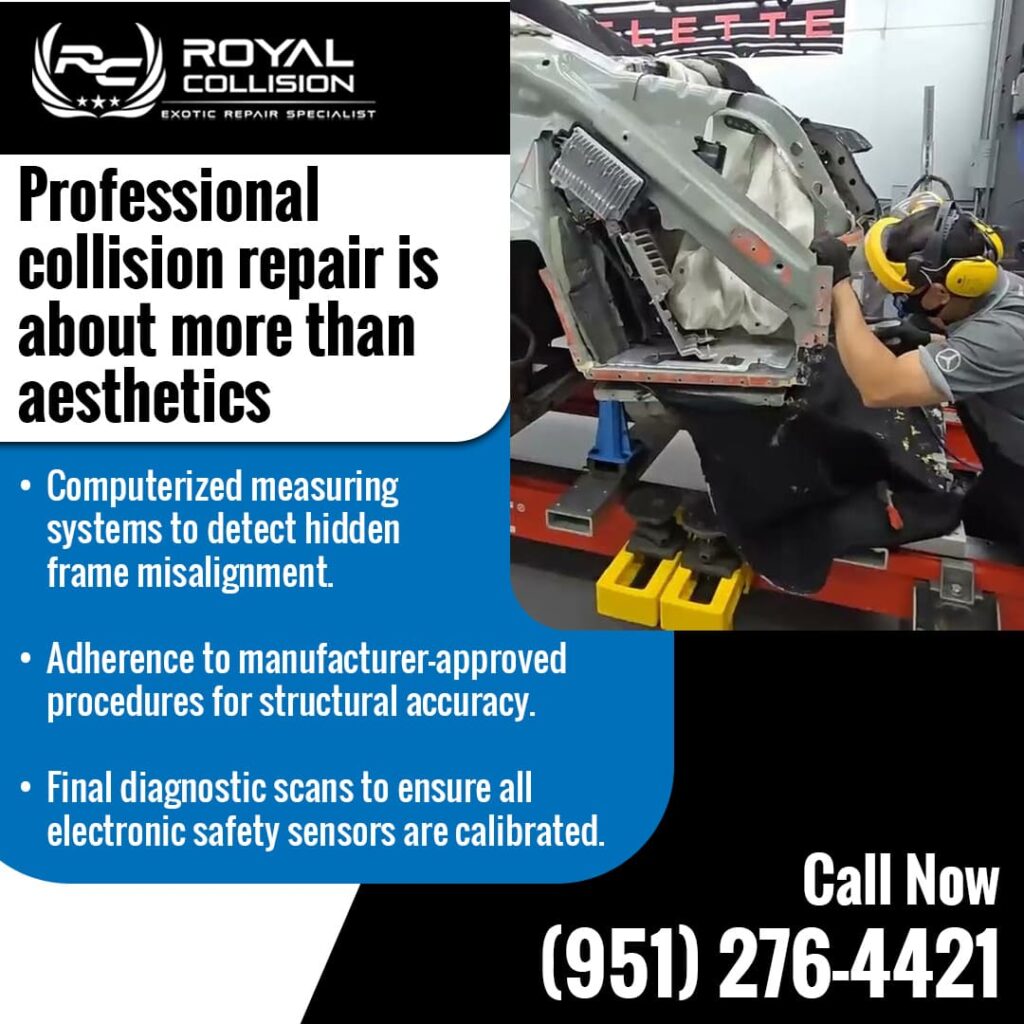
We use Car-o-liner Car-o-matic computerized measuring systems to locate these hidden problems before they compromise your safety. This equipment compares your vehicle’s current dimensions against manufacturer specifications, detecting deviations as small as one millimeter.
Hidden damage creates risks you can’t see initially. Stress fractures weaken load-bearing components. Misalignment causes uneven tire wear. Compromised mounting points lead to handling problems that worsen over time.
Understanding collision damage explains why surface-level repairs don’t provide adequate protection.
Why Professional Collision Repair Goes Beyond Cosmetic Fixes
Surface repairs may make a vehicle look presentable, but they do not address underlying damage. Fresh paint over misaligned panels can hide serious safety concerns. This approach improves appearance while leaving structural problems unresolved.
Structural Accuracy Versus Surface Appearance
Your vehicle’s structural integrity determines how effectively it protects you in a future collision. When frame dimensions fall outside manufacturer specifications, crumple zones cannot perform as designed. The vehicle may no longer absorb impact forces correctly in another accident.
Panel alignment reflects more than visual quality. Misaligned panels often indicate deeper structural issues that affect aerodynamics, allow water intrusion, and interfere with proper door operation. Our collision repair shop in Riverside verifies structural accuracy through precise measurement before addressing cosmetic repairs.
The Difference Between Temporary Fixes and Proper Restoration
Temporary repairs can appear acceptable at first, but often fail with continued use. Repositioning structural components without restoring exact specifications creates short-term improvement while allowing problems to develop.
Common issues from incomplete repairs include:
- Uneven tire wear within months
- Reduced stability during sudden maneuvers
- Accelerated wear on suspension components
- Decreased crash protection in future impacts
Proper restoration follows manufacturer-approved procedures that preserve original safety design. This approach requires specialized equipment, including our Cheetah frame rack and precision measuring systems. We focus on accurate repair methods rather than quick turnarounds because long-term safety depends on correct structural restoration.
Our Professional Collision Repair Process
Systematic repair follows a specific sequence by our certified collision repair technicians. Each step builds on previous work to maintain quality. This process identifies all damage, plans corrections, and verifies results.
Initial Inspection, Damage Assessment, and Disassembly
We begin with controlled disassembly that reveals hidden damage. Our team removes bumper covers, fenders, and panels to expose structural areas. This step reveals mounting points, frame rails, and structural components that visual inspection misses.
Our technicians use Autel diagnostic tools to perform pre-repair scans. These scans identify fault codes in your vehicle’s electronic systems before work begins. Damage assessment documents every affected part photographically and digitally through our CCC estimating system. This documentation guides repair planning and supports your insurance claim.
Developing Manufacturer-Based Repair Plans
Every vehicle manufacturer publishes specific repair procedures for their models. These procedures specify acceptable methods, required parts, and safety requirements. We access these procedures for every vehicle to maintain crashworthiness and prevent future problems.
Modern vehicles use high-strength steel, aluminum, and advanced adhesives in their construction. Using incorrect methods on these materials creates weak points that compromise safety. Our Miller MIG welders and Electron Spot welders meet manufacturer specifications for proper structural repairs on modern vehicles.
| Repair Element | Purpose | Our Equipment |
| Frame Measurement | Verifies structural dimensions | Car-o-liner Car-o-matic |
| Proper Welding | Maintains material strength | Miller MIG, Electron Spot |
| Paint Matching | Achieves factory finish | Spectrometer Camera |
| Diagnostic Scanning | Identifies system issues | Autel Tools |
Frame and Structural Restoration
Frame straightening restores your car’s foundation to factory dimensions. Our Car-o-liner measuring system compares current dimensions against specifications throughout the correction process. This equipment guides our technicians to achieve precise results.
Structural repairs require more than pulling metal back into shape. Heat from welding affects metal strength in high-strength materials. Our I-CAR Platinum-certified collision repair technicians use manufacturer-specified procedures to maintain material properties. The Cheetah frame rack provides the precision needed for accurate corrections that meet factory tolerances.
Paint Refinishing and Quality Verification
After structural repairs, we restore your vehicle’s appearance using Sherwin-Williams paint systems. Our spectrometer camera matches colors precisely, accounting for factory paint variations and weathering effects. The cross-down draft paint booth provides contamination-free refinishing that achieves factory-quality results.
Each vehicle receives careful denib and polish procedures before reassembly. This process creates the smooth, factory-quality finish you expect from professional work. Panel gaps and alignment receive verification to confirm proper structural restoration underneath.
Final Verification and System Checks
We perform post-repair diagnostic scans using Autel equipment to verify that all electronic systems function correctly after repairs. These scans confirm that our work hasn’t created new fault codes or system malfunctions.
For vehicles with Advanced Driver Assistance Systems, we arrange ADAS calibration through certified specialists who have the required equipment. These systems require precise sensor alignment after collision repairs. Lane departure warnings, adaptive cruise control, and automatic braking depend on accurate calibration for proper function.
Proper procedures protect both immediate safety and long-term vehicle performance.
How OEM Parts Maintain Vehicle Safety and Performance
Part quality directly affects repair durability and safety. We prioritize OEM parts for quality and fit, and work with insurers to secure them whenever possible. In some cases where OEM parts are unavailable or not required, certified equivalent parts meeting safety standards may be used.
Why OEM Parts Matter for Structural Integrity
OEM parts match original specifications for dimensions, materials, and attachment methods exactly. These parts fit correctly without modification, maintaining precise tolerances that affect structural alignment. Aftermarket alternatives may vary by several millimeters, creating gaps and weak points in your vehicle’s structure.
Safety components like bumper reinforcements and door beams undergo extensive manufacturer crash testing before approval. OEM parts meet specific strength requirements. Using non-certified alternatives voids manufacturer crash test ratings and compromises your protection during future accidents.
How We Advocate for Proper Parts Despite Insurance Pressure
Insurance companies often push for cheaper aftermarket parts to reduce claim costs. Many collision repair shops participate in Direct Repair Programs that prioritize insurer cost control over repair quality. We operate independently, allowing us to advocate for parts that maintain your vehicle’s safety standards.
We work for you, not insurance companies. This means fighting to secure proper parts and repairs, even when insurers resist. Our team guides you through the insurance process, explaining why OEM parts matter for your safety and supporting claims for appropriate repairs.
Long-Term Protection Through Proper Collision Repair
Correct repairs maintain your car’s performance characteristics for years after restoration. Incorrect repairs create problems that worsen gradually and lead to expensive secondary damage down the road.
Maintaining Suspension Geometry and Handling
Suspension geometry depends on precise mounting point locations measured to millimeter accuracy. When these points shift during collisions, your vehicle’s handling becomes compromised. We restore suspension mounting points to factory specifications during structural repairs to maintain proper geometry.
This precision work provides stable handling and normal tire life after repairs. Skipping proper structural restoration leads to uneven wear patterns, steering pull, and handling issues that appear within months of completing repairs.
Preventing Accelerated Component Wear
Misaligned structures create stress on mechanical systems throughout your vehicle. Engines, transmissions, and suspension components wear faster when mounting points don’t support them correctly. Proper structural restoration distributes loads evenly as vehicle designers intended.
Our mechanical repair capabilities allow us to address related issues discovered during collision repairs. This integrated approach prevents secondary problems that emerge from incomplete structural restoration over time.
Additional Services Supporting Complete Vehicle Restoration
Beyond structural repair, our collision experts in Riverside provide complementary services that support complete restoration. These services address issues commonly discovered during collision repairs.
- Glass Replacement: Damaged windshields and windows receive proper replacement with components that maintain structural integrity. Glass contributes to roof strength and must be installed correctly to support safety systems and structural rigidity.
- Paintless Dent Removal: For minor dents without paint damage, we coordinate in-house paintless dent removal services. This technique preserves your vehicle’s original finish while addressing cosmetic damage efficiently.
- Mechanical Repairs: Collision impacts often affect mechanical components beyond the body structure. Our facility handles mechanical repairs needed after accidents, from suspension work to engine mount replacement and related systems.
Choosing Certified Collision Repair Services in Riverside
Selecting a repair facility affects your vehicle’s safety for years after restoration. Understanding what distinguishes quality shops helps you make informed decisions that protect your investment and safety.
Questions That Reveal Shop Priorities
Ask specific questions about repair approaches before committing to a facility. Honest answers reveal whether shops prioritize quality or cost reduction in their work.
Essential questions to ask collision repair facilities:
- What frame measurement equipment do you use?
- Will you use OEM parts exclusively?
- Do you participate in insurance DRP programs?
- What certifications do your technicians hold?
- How do you handle disagreements with insurance adjusters?
Our answers demonstrate our priorities clearly. We use Car-o-liner measuring systems, exclusively install OEM parts, operate independently of insurance DRPs, employ I-CAR Platinum certified technicians, and advocate for proper repairs regardless of insurer pressure to cut costs.
Why Local Expertise Matters in Riverside
Riverside’s traffic conditions create specific collision patterns we understand well. The 91 Freeway’s heavy congestion leads to frequent rear-end collisions during commute hours. Van Buren Boulevard’s busy intersections see side-impact accidents regularly. We’ve repaired vehicles from these scenarios for over a decade, understanding the damage patterns they create.
Southern California’s climate also affects repair requirements for long-term durability. Heat, occasional rain, and long commutes require refinishing that withstands environmental stress. Our Sherwin-Williams paint systems and proper application techniques provide durable results for local driving conditions.
Restoring Your Vehicle the Right Way After a Collision
Professional collision repair protects safety through complete restoration that addresses structural integrity, safety systems, and long-term performance simultaneously. Surface repairs may look acceptable, but they may not provide adequate protection for you and your passengers during future driving.
We follow manufacturer procedures and use OEM parts exclusively because safety matters more than insurance cost reduction goals. Our team brings over 50 years of collective industry experience, combining knowledge passed through generations with modern equipment and techniques. This expertise maintains the standards that protect Riverside drivers and their families on busy local roads.
Our Limited Lifetime Warranty backs every repair for as long as you own your vehicle. This warranty reflects our confidence in our work quality and commitment to your satisfaction. If issues arise related to our repairs, we address them promptly without excuses or delays.
Professional Collision Repair Riverside CA Drivers Trust
If your vehicle needs proper restoration after an accident, Royal Collision provides thorough evaluation and transparent estimates. We explain the complete scope of damage and repair requirements clearly, helping you understand what’s needed and why it matters for your safety.
Our 6,000 square-foot facility serves Riverside, Moreno Valley, Corona, Jurupa Valley, and nearby communities with collision repair that Riverside CA residents trust for quality and safety. We prioritize proper methods over shortcuts, giving every repair the attention required to restore factory safety standards correctly. Contact us at (951) 276-4421 or ryan@royalcollisionriverside.com.
We’re here to restore your vehicle correctly and get you back on the road safely. Our team guides you through the insurance process, advocates for proper repairs, and delivers results that protect you for years to come.