Most drivers don’t think about the claims process until they’re sitting on the side of the road after a collision. Then the questions arrive fast. Who do you call first? Where does your car go? Will your insurer cover a proper repair?
The body shop insurance claim process involves more steps than most people expect. It also involves more rights than most drivers know about. Each stage of the process affects your repair quality and your costs.
The biggest difference comes from working with a shop that guides you through the process from your very first call. At Royal Collision, we walk customers through how their insurance works on repairs and parts before the car even arrives. Here’s what to expect at each stage.
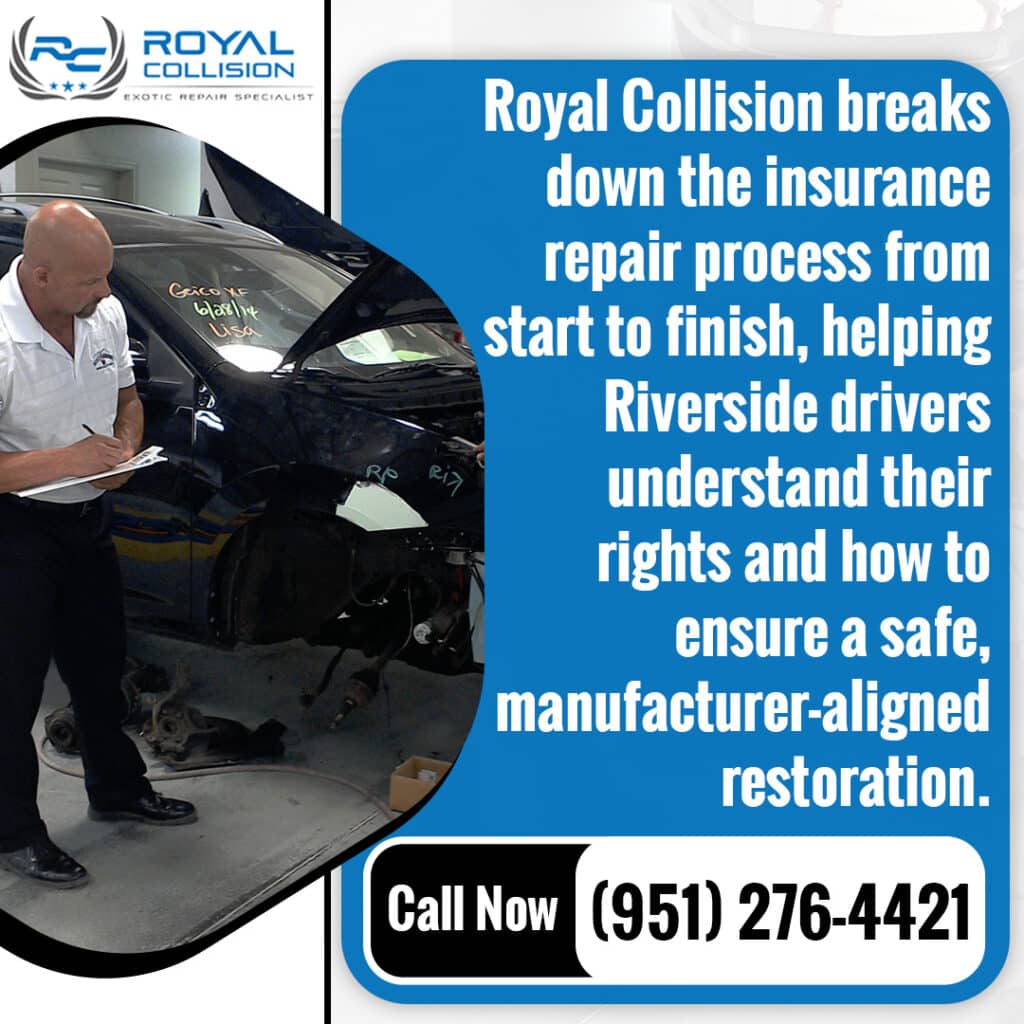
Step 1: Report the Accident and File Your Claim
Before your car goes anywhere, contact your insurance company. This is where the auto insurance claim repair process begins. We walk customers through their insurance coverage and repair options before the car even arrives.
Have the following ready when you call:
- Photos of all visible vehicle damage
- The police report number, if one was filed
- The other driver’s insurance and contact information
Do not sign any paperwork or agree to a settlement before a full repair estimate is completed. Once you file, your insurer will assign a claim number, and we will handle the insurance process from there.
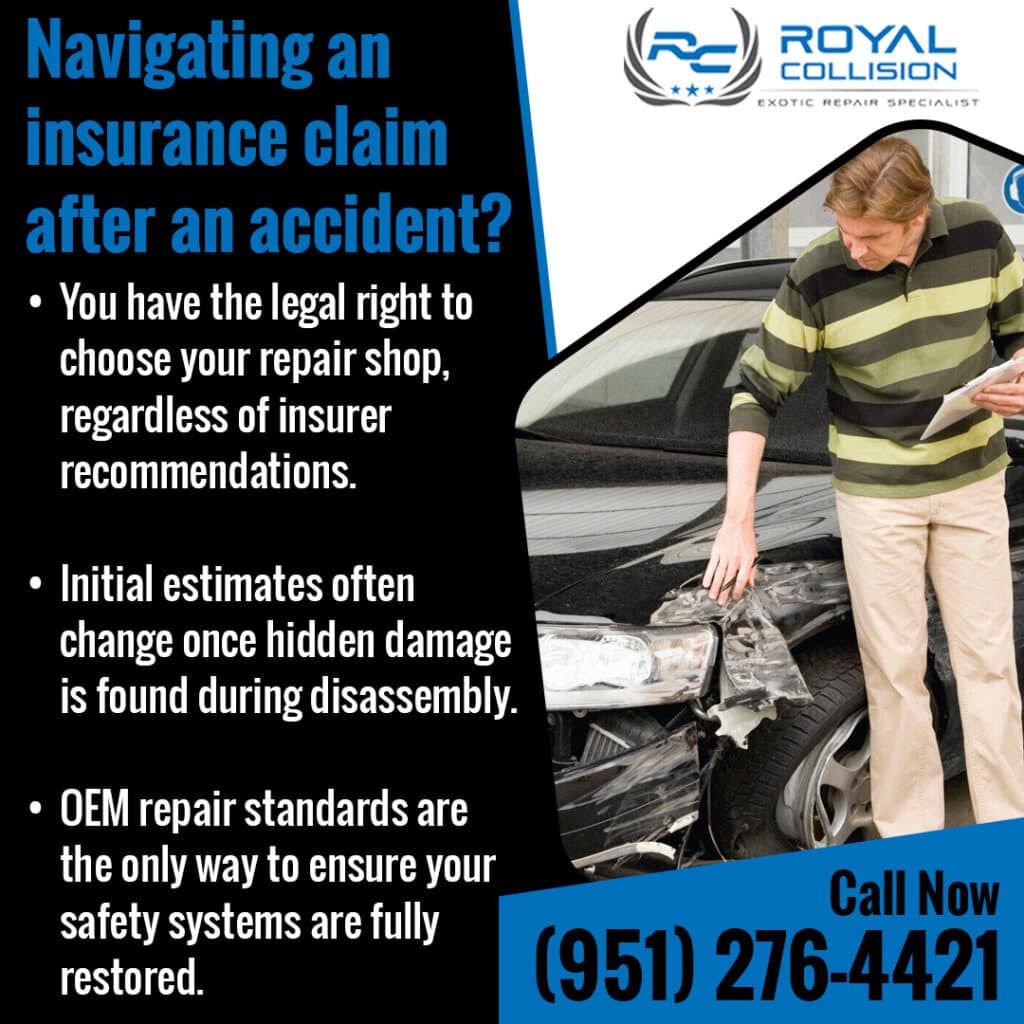
In California, you are not required to use an insurer-recommended shop. You have the legal right to choose your own repair facility. That choice directly affects how your vehicle is repaired. This right is covered in detail in the next step.
Step 2: You Have the Right to Choose Your Own Body Shop
When your insurer recommends a specific shop, it can feel like a requirement. It is not.
Under California law, enforced by the Bureau of Automotive Repair, an insurance company cannot require you to use a particular repair facility. Per the California Department of Insurance’s Auto Body Repair Consumer Bill of Rights, consumers have the right to select their preferred licensed repair facility. You choose where your vehicle goes.
Many insurers direct customers to Direct Repair Program (DRP) shops. These shops operate under agreements with insurance companies that help manage claim costs. Those agreements may prioritize what is cheapest for the insurer over what your specific vehicle actually needs.
We carry zero DRP agreements, and every repair decision reflects your vehicle’s needs, not an insurer’s budget. Your vehicle’s safety after a collision depends on repair quality, not just speed or price. When you compare collision repair insurance options, a shop’s independence matters as much as its technical ability.
What is Insurance Steering and Is it Legal?
Insurance steering happens when an insurer directs you toward a preferred shop without disclosing that shop’s cost-control agreements. Insurers can recommend a shop. They are not permitted to deny your claim or penalize you for choosing a different one.
California law protects your right to bring your vehicle for an insurance claim to the body shop of your choice. Your insurer must work with any licensed facility you select.
Step 3: What Happens When Your Vehicle Arrives at the Shop
A quality shop follows a defined sequence before any work begins. This protects your vehicle and produces a repair plan that holds up with your insurer. Here’s how our auto body repair process works, from intake through approval:
- Vehicle preparation: The car is prewashed. Seat covers, floor mats, and door jamb tape are placed to protect the interior before any work begins.
- Disassembly: Technicians remove panels to expose the full scope of damage. Collision damage frequently hides below surfaces that look undamaged from the outside.
- Pre-repair scan: After disassembly begins, we scan the vehicle using Autel diagnostic tools. This identifies electronic fault codes triggered by the impact.
- Repair plan: Based on actual findings, a complete repair plan is written and documented with photos.
- Submission to customer and insurer: The repair plan, OEM procedures, and supporting photos go to both you and your insurer at the same time. This documentation gives your insurer a clear, verifiable standard to evaluate.
- Review, options, and approval: Once the insurer responds, we review the outcome with you and walk through your repair options. Parts are ordered only after you give final approval.
At Royal Collision, we follow this sequence on every vehicle. It is the foundation of a legitimate body shop insurance claim and our basis for advocating on your behalf.
Step 4: The Insurance Estimate And The Supplement Process
The first number your insurer puts on paper is rarely the final one. That’s an important part of how collision repair insurance works.
Insurance adjusters often prepare initial estimates using photos or a quick inspection. They cannot see behind panels or inside structural areas where damage is common. Once the vehicle is fully disassembled at the shop, the actual repair cost often changes.
When hidden damage is found, your insurance claim at a body shop moves into the supplement stage. A supplement is a formal request sent to your insurer for additional funds to cover the full repair. This is a normal part of any auto insurance claim repair process.
A shop that accepts the first estimate without review may limit repairs to fit that number. A shop that documents everything properly creates a stronger case for a complete and safe repair.
What Do OEM Repair Procedures Mean in Your Claim?
OEM stands for Original Equipment Manufacturer, the company that built your vehicle.
OEM repair procedures are the exact methods provided by the manufacturer for repairing each component. These procedures are critical for modern vehicles with advanced materials and safety systems.
Submitting OEM documentation during a collision repair insurance claim establishes a clear repair standard. It helps protect your vehicle’s structure, safety systems, and long-term performance.
Step 5: OEM parts vs. aftermarket parts
One of the most common disagreements while a body shop handles insurance claims involves parts selection.
Insurance companies may approve aftermarket or used Like Kind and Quality (LKQ) parts to reduce costs. OEM parts cost more, but they are produced by the original manufacturer and designed to match your vehicle’s exact specifications.
Aftermarket parts may fit differently and may not perform the same in a future collision. For newer vehicles with ADAS (Advanced Driver Assistance Systems), incorrect parts can affect sensor alignment and calibration. Some issues may not appear until the system is needed.
As part of your collision repair insurance coverage, California regulations allow you to request OEM parts. OEM parts are used on every repair at Royal Collision, and documentation is provided to support proper collision repair decisions when alternatives are suggested.
| Feature | OEM Parts | Aftermarket Parts |
| Manufactured by | Original vehicle manufacturer | Third-party supplier |
| Fit and finish | Exact match to original vehicle | May vary |
| Warranty compatibility | Typically maintained | May affect manufacturer standards |
| Safety certification | Meets original crash-test specifications | Not always tested to the same level |
| Cost to insurer | Higher | Lower |
Step 6: When Repairs Begin and What Affects The Timeline
Once you approve the repair plan and parts are confirmed, repairs begin. At that point, the timeline becomes clear rather than at intake.
Several factors influence timing:
- Parts availability, especially when OEM components are required
- The extent of structural damage identified during disassembly
- Paint curing time and paint booth scheduling
A consistent auto insurance claim repair process avoids early estimates that may change later. Timelines are provided only after the complete repair plan is finalized, and parts are secured. This gives you a more accurate expectation based on real conditions.
For customers managing collision repair in Riverside, CA, updates are shared throughout the process, from parts arrival through final inspection.
Step 7: Post-Repair Inspection and How to Know the Job Was Done Right
Before you accept your vehicle, a complete post-repair inspection confirms the work meets the planned repair standard. This step is critical in any insurance claim for collision repair.
Here’s what to review and ask about:
- Post-repair scan: After repairs are complete, the vehicle is scanned again using Autel diagnostic tools to confirm all electronic systems are working correctly. Ask for copies of both the pre- and post-repair scan reports. These documents show the starting condition and the final verified result.
- Panel alignment: Gaps between panels should match factory specifications. Uneven gaps may indicate incomplete structural correction.
- Paint match: A proper refinish should blend with the original finish. Color matching is completed using a spectrometer and a Sherwin-Williams paint system applied in a controlled booth environment.
- Final detail: Before delivery, the vehicle is fully cleaned inside and out so you receive it in finished condition.
If the repair does not meet OEM standards, you can request a re-inspection before accepting the vehicle as part of your insurance claim.
What Will You Pay Out of Pocket?
The National Highway Traffic Safety Administration reported about 6.1 million police-reported crashes in the U.S. in 2021. Your deductible is your financial responsibility. It is set by your insurance policy, not your repair shop.
Beyond that, your total cost depends on how your claim is handled and documented. CA properly managed collision repair insurance claim accounts for the full scope of damage instead of relying on an incomplete estimate.
A shop that reviews estimates carefully and submits detailed supplements improves the likelihood that repairs are covered beyond your deductible. This step plays a key role in a complete auto insurance claim repair.
At Royal Collision, about 95% of customers pay only their deductible. The team works directly with your insurer, managing documentation, supplements, and approvals throughout the body shop’s insurance claim process, so you are not left handling it alone. All repairs are backed by a Limited Lifetime Warranty on workmanship and paint, since warranties come from the shop performing the repair.
Frequently Asked Questions
Why did my estimate change after the shop started the repair?
Initial estimates are often written before full disassembly. Hidden damage is only visible once panels are removed. When additional damage is found, the shop submits a supplement to cover the true repair cost. This is a normal, expected part of the process.
Who handles the back-and-forth with my insurance company?
If you have an insurance claim, the body shop should handle it. A good shop manages the documentation, supplements, and parts decisions on your behalf. Your job is to stay informed and approve the plan, not to negotiate with an adjuster.
Work With a Shop That Fights For Your Repair
The collision repair insurance process involves more steps than most drivers expect. Knowing your rights changes the outcome.
You have the right to choose your shop, request OEM parts, review the repair plan before work begins, and ask for pre- and post-repair scan documentation before accepting your vehicle.
The cheapest repair is not always the right one. A shop that works for you will push back when a proper repair is underfunded and advocate for what your vehicle actually needs.
At Royal Collision in Riverside, CA, we handle the insurance process from the first step to the final inspection. Contact us at (951) 276-4421 or ryan@royalcollisionriverside.com to schedule an appointment for collision repair in Riverside, CA.