Yes, you can. California law gives you the right to select your own repair facility after a collision, regardless of what your insurer suggests. Your choice of body shop for an insurance claim does not have to be by your insurance company.
This matters more than most drivers realize. Today’s vehicles carry sensors, structural components, and safety systems that demand precise repairs. A shop focused on insurer cost targets may not follow the same repair standards as one committed to manufacturer procedures.
At Royal Collision, we guide Riverside-area drivers through the collision repair and insurance claim process from start to finish. Knowing your rights after a crash helps you protect your vehicle, your safety, and your long-term investment.
What Does California Law Say About Choosing a Collision Repair Shop?
California Drivers Have the Right to Select Their Repair Facility
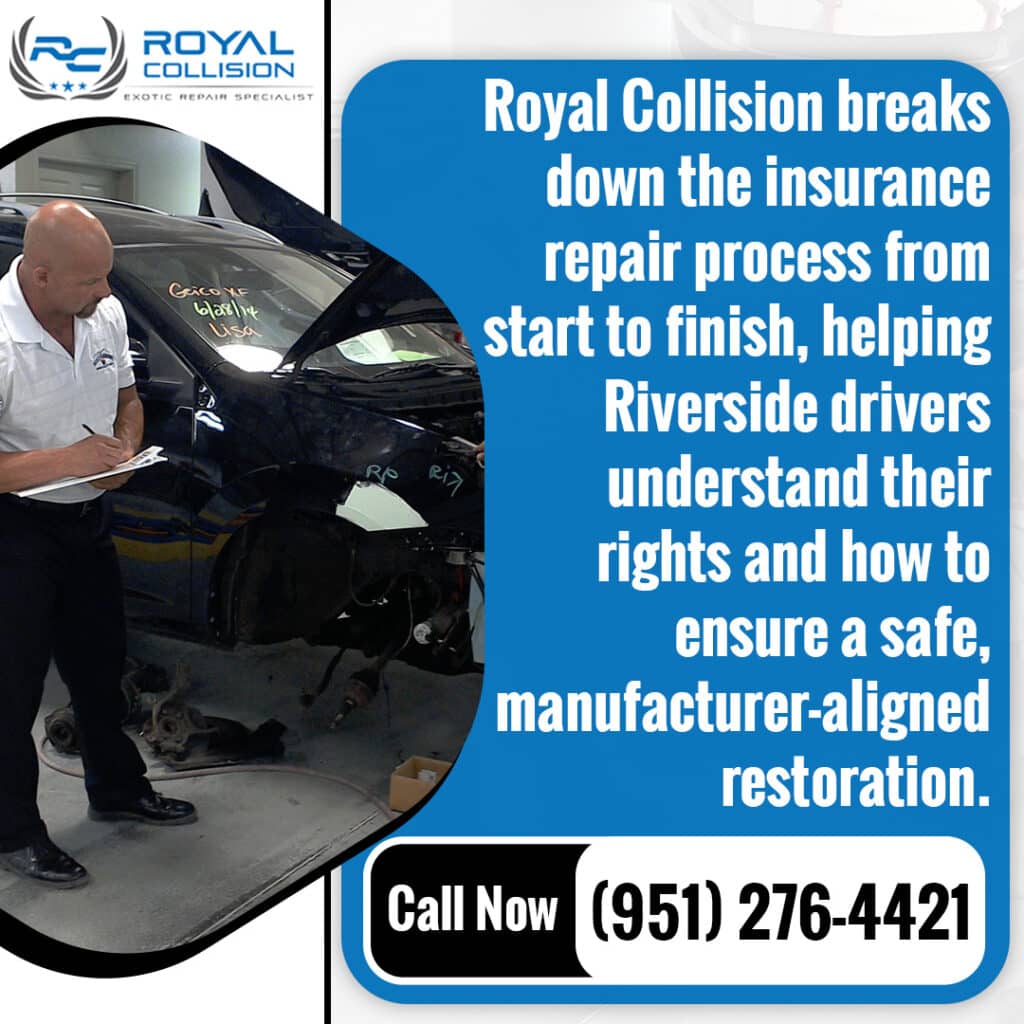
California Insurance Code Section 758.5 protects your right to choose your own repair shop after an accident. Your insurer cannot require or coerce you into using a specific repair facility as a condition of your coverage, although they may recommend participating shops or provide estimates based on their network. This applies whether you are filing through your own policy or a claim against another driver’s insurance.
The California Department of Insurance (CDI) enforces insurance consumer protection laws. If an insurer engages in coercive steering practices, misrepresents your rights, or penalizes you for selecting a repair shop, it may constitute a violation of state insurance regulations. The same applies if your coverage is threatened because you chose an independent facility. You can review your rights or file a complaint.
Why Insurance Companies Recommend Certain Shops
Many insurers maintain networks of repair facilities called Direct Repair Programs, or DRPs. These programs allow insurers to manage claims volume and control costs. Shops in a Direct Repair Program (DRP) agree to insurer-defined guidelines, which may include pricing structures, parts usage policies, documentation requirements, repair procedures, and performance metrics such as repair timelines.
That arrangement can work for routine repairs. It also means the shop’s obligations may prioritize meeting insurer cost targets over following manufacturer repair procedures. We are not part of insurer Direct Repair Programs (DRPs), allowing us to focus on repair decisions based on manufacturer requirements and vehicle safety standards. Our repair decisions are based on what your vehicle requires, not on what saves an insurance company money.
Why Your Choice of Body Shop Matters After a Collision
The quality of collision repair directly affects how your vehicle performs, how well it protects you in a future crash, and what it is worth when you sell it. California law gives you the right to select your own repair facility after a collision, regardless of what your insurer suggests.
Many drivers want to handle their insurance claims at body shops after accidents. Choosing a repair facility that follows OEM procedures can affect vehicle safety and long-term performance.
Modern Vehicles Require Precise Repairs
Late-model vehicles use high-strength steel, aluminum alloys, and complex sensor networks. These materials require specific tools, documented procedures, and a defined repair sequence. Improper welding, misaligned panels, or skipped diagnostic steps can leave hidden damage that affects performance and crash protection.
After disassembly begins, we conduct a pre-repair scan to identify fault codes and system issues before writing the repair plan. This sequence matters because damage not visible during an initial walk-around often only surfaces once the vehicle is disassembled and properly scanned.
OEM Repair Procedures Protect Vehicle Integrity
OEM repair procedures are the manufacturer’s documented instructions for restoring a vehicle after damage. They specify welding methods, part replacement sequences, adhesive types, and structural correction techniques. Skipping these steps can compromise the vehicle’s crash energy management system.
We follow OEM procedures on every repair and submit this supporting documentation to your insurer along with the repair plan. This helps justify proper repairs and supports accurate reimbursement on your collision repair insurance claim.
The Cheapest Repair Option Is Not Always the Best Long-Term Choice
A low estimate can reflect cut corners: non-OEM parts, skipped scans, or procedures that do not meet manufacturer standards. Problems from improper repairs may appear months later as frame misalignment, sensor faults, or safety system failures. These issues may not be covered under any warranty if the original work did not meet factory specifications.
How the Auto Insurance Claim Repair Process Usually Works
Step 1: File the Insurance Claim
Contact your insurer after an accident to file a claim. Provide your policy number, date of loss, and the other driver’s information when applicable. Then choose your repair shop independently, before anyone pressures you toward a preferred facility.
Step 2: Schedule a Repair Inspection and Plan
After selecting a shop, schedule your vehicle drop-off for a formal inspection. At Royal Collision, we begin by prewashing the vehicle and protecting the interior with seat covers, floor mats, and door jamb tape. Disassembly follows to expose all damage. We then perform a pre-repair scan and write a detailed repair plan supported by photos and manufacturer procedure documentation.
Step 3: Insurance Review and Repair Authorization
We submit the repair plan, photographs, and OEM procedure documentation to your insurer. If the insurer’s estimate differs from ours, we work through the supplement process and document all identified damage. You review and approve the final plan. We order parts only after you approve.
Step 4: Repairs, Scanning, and Delivery
Repairs follow the approved plan. We use our Cheetah® frame rack and Car-o-liner Car-o-matic measuring system for structural correction. Panel repair follows, with all parts checked for proper fitment before reassembly. Refinishing with the Sherwin-Williams paint system and full reassembly completes the process. After reassembly, we perform a post-repair scan. When required, ADAS (Advanced Driver Assistance Systems) calibration is performed through certified calibration providers to ensure proper function of safety-critical systems such as lane assist, adaptive cruise control, and collision avoidance. The vehicle receives a full detail before delivery.
Questions to Ask To Help Deal With Insurance Claim and Body Shop Choice
Asking the right questions before approving any repairs puts you in control of the outcome. Drivers who want body shops to handle insurance claims should ask detailed questions before approving repairs or replacement parts.
| Question | Why It Matters |
| Do you use OEM parts? | Maintains factory fit, safety standards, and sensor compatibility |
| Do you follow OEM repair procedures? | Preserves structural integrity and crash energy management |
| Will the vehicle receive pre- and post-repair scans? | Confirms hidden damage and verifies all safety systems are functioning |
| How will you communicate with my insurance company? | Protects your claim and supports accurate repair reimbursement |
| Is there a warranty on repairs? | Adds long-term accountability for workmanship and parts quality |
Do You Use OEM Parts?
OEM parts are manufactured by or for your vehicle’s original maker. They match your vehicle’s specifications for fit, material quality, and safety performance. Aftermarket parts may look similar, but are not always held to the same standards. We use OEM parts exclusively on every repair we perform.
Do You Follow Manufacturer Repair Procedures?
Every vehicle has published manufacturer repair procedures covering welding specs, panel sequences, and sensor recalibration requirements. Shops that skip these steps may produce repairs that look complete but do not meet factory standards. We submit OEM documentation with every repair plan we send to insurers.
Will the Vehicle Receive Pre- and Post-Repair Scans?
A pre-repair scan identifies existing fault codes before work begins. A post-repair scan confirms no new codes were triggered during the repair process. We use Autel diagnostic tools to perform both scans on every collision repair job.
How Will You Communicate With My Insurance Company?
We contact your insurer directly after you file your claim. We document all damage, submit procedure documentation, and handle any supplement disagreements on your behalf. You stay informed throughout.
Is There a Warranty on Repairs?
In most cases, the repair shop, not the insurance company, provides the warranty for collision repairs. Warranty terms vary by shop and should always be reviewed before approving work. We back every repair and refinishing job with a Limited Lifetime Warranty for as long as you own the vehicle. Always ask about warranty terms and confirm what is covered before you approve any work.
Common Misunderstandings About Collision Repair Insurance
“I Have to Use My Insurance Company’s Preferred Shop”
You are not required to use your insurer’s preferred shop. If an adjuster pressures you, ask them directly to identify the policy language that requires it. You can also report steering behavior to the California Department of Insurance online. Choosing your own repair facility is a protected right, not something that requires insurer permission.
“Aftermarket Parts Are Always the Same as OEM Parts”
Aftermarket parts are made by third-party manufacturers and may differ in fit, material composition, and safety performance. They are not always tested to the same standards as OEM components. Insurers sometimes request them to reduce claim costs. You have the right to ask what parts are being installed on your vehicle and to request OEM alternatives.
“If the Car Looks Fine, the Repair Was Done Correctly”
A vehicle can appear cosmetically complete while still having structural or sensor-related issues. Frame misalignment, incomplete welds, and uncalibrated safety systems are not visible. Post-repair scanning and frame measurement confirm whether the vehicle meets manufacturer specifications.
“Insurance Companies Provide the Warranty on Repairs”
Insurance companies do not warrant collision repairs. If a shop in an insurer’s preferred network produces poor work, the insurer typically disclaims responsibility for the result. That obligation falls entirely on the repair shop. A written warranty from the shop you choose is your only protection. Confirm it is documented and clearly defined before any work begins.
Choosing a Collision Repair Shop in Riverside, CA
Riverside County drivers drive through some of the highest-traffic corridors in Southern California. The 91 freeway, I-215, and SR-60 carry millions of commuters each year, and rear-end collisions, lane-change incidents, and intersection crashes occur regularly across Jurupa Valley, Moreno Valley, Grand Terrace, Colton, and Redlands. California consistently ranks among the states with the highest collision volume, making informed shop selection a practical priority for local drivers.
Finding a body shop for insurance claim processing means finding a shop with local experience in both technical repairs and insurance advocacy. Supplemental damage documentation, insurer pushback on parts, and repair authorization delays are common challenges. A shop that handles these routinely reduces the burden on you throughout the process. When choosing a provider of collision repair in Riverside, CA, opt for a shop like Royal Collision that communicates clearly and follows manufacturer repair standards.
What to Expect From a Customer-Focused Collision Repair Shop
At Royal Collision, we work for you from your initial call to the day your vehicle is delivered. We hold no agreements with insurance companies that limit what we can do on your repair. Our body technician has 30 years of industry experience, and our painter has 15 years in the trade. That depth of experience matters when we are fighting for the right repair on your behalf.
Here is what that looks like in practice:
- We walk you through the insurance process before your vehicle is even dropped off.
- We document all damage, submit manufacturer procedure documentation, and advocate for proper repairs.
- We communicate with your insurer directly through every step, including the supplement process when needed.
- We provide a repair timeline only after the repair plan is complete, and we have ordered your parts. That is when we can give you an accurate projection.
- Every repair is backed by a Limited Lifetime Warranty.
Our customers appreciate our assistance with auto insurance claims for repairs. Merlin J., one of our customers, left us this Google review: “Great experience with Royal Collision. Ryan did an amazing job and made my car look brand new. He helped with the insurance claim, made sure I got the right parts, and kept me updated the whole time. Really glad I went back—highly recommend. “ About 95% of our customers pay only their deductible. Most pay nothing out of pocket for OEM parts and OEM-procedure repairs. If you have questions about what your coverage allows, contact us to talk through your specific situation.
Choosing Your Own Body Shop in California
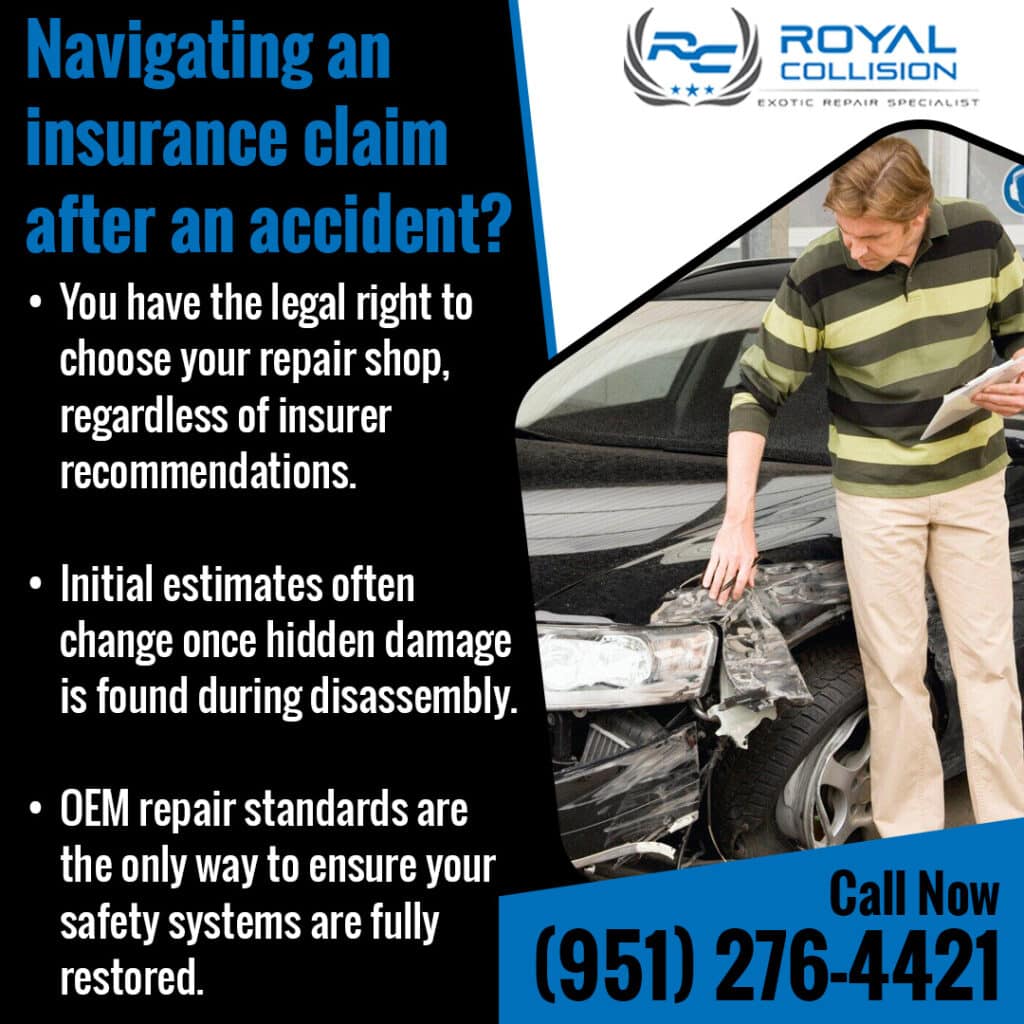
California drivers have clear legal protections when it comes to selecting a repair facility after a collision. You are not required to use an insurer’s preferred shop, and you have every right to request OEM parts and manufacturer-based repair procedures on your auto insurance claim repair.
Proper collision repair affects more than appearance. It directly impacts structural integrity, safety system function, and your vehicle’s long-term value. Asking the right questions before repairs begin puts you in a stronger position to get the outcome your vehicle and your safety deserve.
If you need guidance regarding collision repair in Riverside, CA, or a nearby area, contact Royal Collision at (951) 276-4421 or ryan@royalcollisionriverside.com. We will walk you through the insurance process, review your options, and make sure your vehicle is repaired the right way.