After a collision, the condition of your vehicle’s body panels directly affects its safety, structural performance, and long-term reliability. Not all damage looks the same, and not all damage requires the same solution. Many drivers assume that when two or more panels are affected, every one of them must be replaced. That is not always the case.
Royal Collision is a family-owned car body shop in Riverside with over 10 years of service. We evaluate every vehicle thoroughly before recommending a repair path. We explain how skilled technicians restore multi-panel collision damage without unnecessary panel replacement, and what that process looks like from inspection through refinishing.
What Multi-Panel Damage Actually Means
Understanding how multi-panel damage develops explains why every stage of the repair process matters.
What Qualifies as Multi-Panel Damage
Multi-panel damage refers to any single collision event affecting two or more adjacent body panels. This outcome is more common than isolated single-panel impacts, given how modern vehicles are built.
Typical examples include:
- A front fender and door damaged by a side impact
- A door and rear quarter panel affected by an angled collision
- A rear bumper cover and quarter panel displaced by a rear-end hit
Why Damage Spreads Across Panels
Adjacent panels share mounting points and structural seams. Force absorbed by one panel travels into neighboring panels. Vehicle manufacturers design this deliberately. Spreading crash energy across connected structures reduces the load on vehicle occupants.
Collision damage rarely stays confined to the point of contact. Parking lot sweeps and intersection side impacts spread force across multiple panels. So do lane-change accidents and rear-end collisions that compress panels together.
We inspect every affected panel before any repair plan is written. Stopping at visible surface damage alone leaves hidden structural problems unaddressed.
Why Panel Repair Is Often Preferred Over Replacement
Replacement appears to be the more complete solution on the surface. In practice, it introduces tradeoffs that experienced technicians weigh carefully before recommending it.
Factory-welded panels bond permanently into the vehicle’s structure. Removing one means cutting through seams not designed to be reopened. It also disturbs the corrosion-resistant coatings that the factory applied during manufacturing. Those coatings protect the underlying metal from moisture across the vehicle’s lifespan. Repairing the panel instead keeps factory welds and those protective layers intact.
Repair is the preferred approach when metal deformation is within recoverable limits and structural mounting points remain intact.
Before reaching that conclusion, our technicians evaluate:
- Degree and distribution of metal deformation
- Condition and integrity of factory welds
- Structural alignment at mounting hardware
- Substrate condition beneath the panel surface
Each factor determines whether a panel can hold a quality repair over time.
| Repair Approach | Primary Benefit |
| Metal repair andrefinishing | Factory welds, corrosion protection, and original panel alignment are preserved |
| Panel replacement | Applied only when metal is torn, mounting points fail, or structural safety is compromised |
Every repair-versus-replacement decision follows OEM procedures. Those procedures exist for structural and safety reasons, not cosmetic ones.
How Car Body Shops Repair Multiple Damaged Panels: Step by Step
Preparation, technical skill, and purpose-built equipment determine the quality of a multi-panel repair at every stage.
Step 1: Assessment, Scanning, and Repair Planning
The vehicle is washed before any disassembly begins. Floors, seats, and door jambs are protected with covers and tape. Our technicians then conduct a full visual assessment of all affected panels and run a pre-repair scan with our Autel diagnostic equipment to capture any collision-triggered electronic fault codes.
At Royal Collision, we compile all findings into a written repair plan that includes photos and references to the applicable OEM repair procedures. This plan goes to both the customer and the insurance carrier. Parts are not ordered, and no physical work begins until the customer has reviewed and approved the plan.
Step 2: Controlled Disassembly and Hidden Damage Identification
Trim components, moldings, and lighting assemblies are carefully removed to expose panel edges and the internal structure behind exterior surfaces. What appears to be a two-panel repair frequently reveals additional affected areas once this layer is pulled back. The disassembly stage gives our technicians an accurate picture of the total scope before any metal work begins.
Step 3: Metal Reshaping and Structural Correction
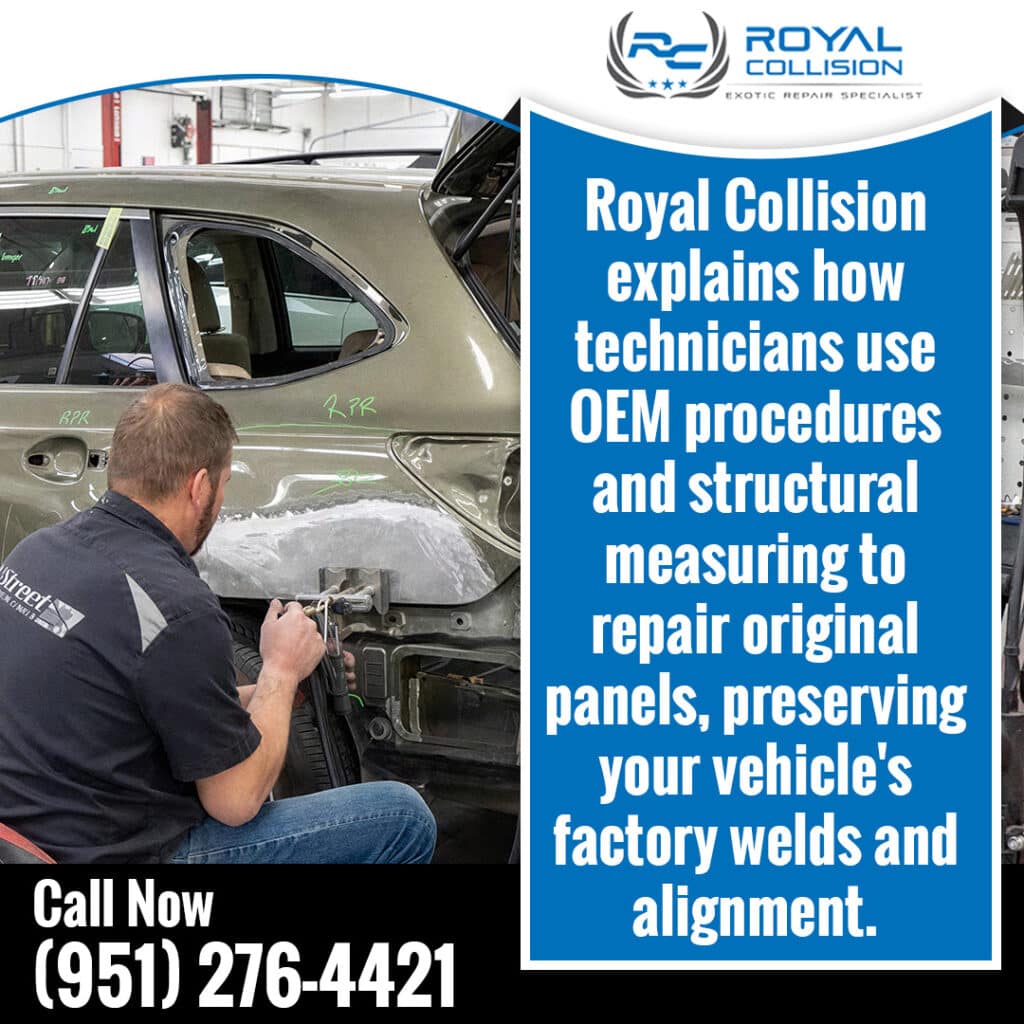
Our technicians work damaged metal back toward factory dimensions using dent pulling systems, stud welders, body hammers and dollies, hydraulic pulling systems for larger deformations, and Miller MIG welders for areas requiring metal repair.
We reshape panels in deliberate, staged movements. Rushing this process overstretches or tears metal that could otherwise be recovered.
When the collision force has reached the underlying structure, we use the Cheetah® frame rack alongside the Car-o-liner Car-o-matic measuring system. This equipment captures structural dimensions across multiple vehicle points simultaneously. Corrections continue until all readings match manufacturer specifications.
Step 4: Fitment Check Before Paint
Repaired and replaced panels are checked against adjacent panels for proper fitment before any paint is applied. Gap consistency, door and hood alignment, and hinge function are all confirmed at this stage. Finding and correcting alignment issues before refinishing prevents rework later.
Step 5: Refinishing and Final Inspection
We sand and prime each panel to prepare the surface properly. Color matching is handled through our spectrometer camera, which reads the vehicle’s existing paint and generates a precise formulation matched to it. Paint is applied inside our cross-down draft booth, where airflow, temperature, and contamination are controlled throughout the process. After curing, technicians denib and polish the surfaces. Color is reviewed visually before any reassembly begins. A post-repair scan with our Autel equipment runs after reassembly to confirm no active diagnostic fault codes remain.
The Equipment That Makes Panel Repair Accurate
Without purpose-built tools, panel replacement often becomes the default choice. Not because the panel cannot be repaired, but because the shop lacks the equipment to do it properly. Here is what our technicians use.
Structural Measuring and Frame Correction
The Cheetah® frame rack and Car-o-liner Car-o-matic measuring system work together to restore structural accuracy. The measuring system captures dimensional data across multiple structural points simultaneously. It identifies deviations from factory specifications. The frame rack then applies controlled correction until all measurements return to the manufacturer’s tolerances.
Panel Pulling and Metal Forming Equipment
Stud welders and pulling towers apply controlled, directional force to deformed areas without cutting into the panel. Working through calibrated adjustments, technicians move metal back toward its original position. Our Miller MIG and Electron Spot welders handle areas where metal repair is needed before pulling.
Spectrometer Color Matching
Our spectrometer camera reads the spectral data of the vehicle’s existing paint and generates a matched color formulation. Repaired panels align precisely with surrounding surfaces in both color and finish.
Cross-Down Draft Paint Booth
All refinishing takes place inside our cross-down draft booth using the Sherwin-Williams paint system. Regulated airflow and controlled temperature keep contamination out throughout the application. The result is an even, durable finish that meets California air quality standards.
When Panel Replacement Is the Correct Decision
Repair is the preferred path when conditions allow, but certain damage levels require full replacement. At our auto body repair shop, we make that call based on what the inspection reveals, not on what is easier.
Replacement is required when metal has been stretched or torn beyond what reshaping can recover, when structural mounting points are damaged, when underlying rust has degraded the panel below a reliable threshold, or when components that carry structural loads are compromised.
Panels most frequently replaced after high-severity impacts include quarter panels with extensive structural deformation, rocker panels that have experienced significant inward collapse, and structural reinforcement panels that no longer meet load requirements.
When replacement is needed, we source OEM parts exclusively. Salvaged or aftermarket panels are not installed on any vehicle we repair. Each replacement recommendation is communicated to the customer with photos and written documentation explaining the specific findings that led to that decision. Replacement is never suggested as a convenience or a time-saving measure.
Why Multi-Panel Repairs Demand Experienced Technicians
Multi-panel collision work requires precision beyond straightening visible surfaces. Every restored panel must align correctly with the panels surrounding it. Factory tolerances where doors meet fenders, hoods meet quarter panels, and bumper covers meet lower trim are tight by design.
When those tolerances are missed, consequences develop over time. Uneven panel gaps become visible from across the parking lot. Wind noise enters the cabin through seams that no longer close properly. Water finds paths through misaligned edges, causing rust in areas that are difficult to access. Paint edges that were not fully prepared during refinishing begin failing months after the repair.
These failures rarely appear immediately after a poorly executed job. They surface later, once connecting the problem back to the original repair becomes much harder.
Our team includes I-CAR Platinum-certified technicians. Both our body technician and our painter hold this credential. It reflects advanced technical training and a commitment to ongoing education as vehicle repair standards evolve. Our body technician brings 30 years of hands-on repair experience. Our painter has 15 years of experience in refinishing. That depth of experience is what separates accurate multi-panel work from repairs that only appear correct at first glance.
A professional car accident repair shop handles both the visible and the technical layers of collision damage. Our process addresses both.
What the Data Says About Collision Repair and Vehicle Safety
The scale of collision damage in the United States gives useful context for why repair quality carries real consequences.
| Statistic | Figure |
| Total police-reported crashes in the U.S. (2021) | 6.1 million |
| Crashes involving property damage only, no fatalities (2021) | Approximately 73% |
Nearly three out of four police-reported crashes involve vehicles that remain drivable after the impact. These are not total losses. They return to the road after repair. The quality of that work determines how they hold up in a future collision.
Incompletely repaired panels reduce a vehicle’s structural capacity. Crash energy that should travel through connected structures gets disrupted. Safety systems tied to structural geometry may not perform as designed. Proper repair addresses all of those factors, not only surface appearance.
Questions Drivers Ask About Multi-Panel Repairs
What parts do you use when panels need to be replaced?
We use OEM parts on every vehicle, no exceptions. Aftermarket or salvaged panels are never used. OEM components maintain the factory fit, structural ratings, and long-term reliability that the vehicle was originally built with.
How does insurance factor into panel repair decisions?
We build a complete repair plan with supporting photos and OEM procedure references. We submit it directly to your insurer and handle all communication on your behalf. We advocate for the repair your vehicle actually needs. Based on our experience, 95% of customers pay nothing beyond their deductible for OEM parts and OEM procedures.
Is this type of repair covered by a warranty?
All repair work and paint refinishing are covered under our Limited Lifetime Warranty for as long as you own the vehicle. Parts carry the manufacturer’s warranty terms. If a workmanship issue appears after delivery, we address it.
How to Choose the Right Car Body Shop for Multi-Panel Collision Work
Not every shop has the tools, training, or repair philosophy to handle this type of work at the standard it requires.
What to Evaluate Before You Commit
When comparing body shops in Riverside for multi-panel collision repairs, these factors determine what kind of result you receive:
- OEM repair procedures are followed on every job, without substitution
- Pre-repair and post-repair electronic scanning performed in the shop
- Structural measuring and frame correction equipment available on site
- Technicians with verifiable professional credentials
- A written, photo-supported repair plan is provided before work begins
When looking for a dependable auto body shop in Riverside, CA, repair standards and available equipment matter more than convenience or quick turnarounds. Royal Collision does not participate in Direct Repair Programs. No insurance carrier influences how we evaluate or repair your vehicle. Our recommendations follow manufacturer guidelines and the actual condition of the vehicle. You receive straightforward communication from the initial inspection through final delivery. We represent your interests directly with your insurance company whenever proper documentation is needed to support the repair your vehicle requires.
Here is a Google review by Matt, one of our customers, “If you care about your vehicle and want it repaired the right way, this is the place to go. They treat your car like it matters, and they treat you with respect. I would absolutely trust them again and would recommend them to anyone who wants quality work done right the first time.”
Sound Assessment Leads to Repairs That Last
Multi-panel damage does not automatically require panel replacement. Technicians with the right training and equipment can recover many panels through metal work, structural correction, and accurate refinishing. The decision between repair and replacement follows OEM procedures and careful physical assessment, not assumptions about what looks easier or faster.
The quality of the repair your vehicle receives after a collision affects its structural integrity, the durability of the finish, and how safety systems perform in a future impact. Getting that right from the start matters.
Royal Collision in Riverside handles multi-panel damage with documented repair plans, OEM parts, manufacturer-specified procedures, and technicians whose credentials and experience are verifiable. Every repair and paint job is backed by a Limited Lifetime Warranty valid for as long as you own the vehicle. If your vehicle has sustained multi-panel damage, call us at (951) 276-4421 or send us an email at ryan@royalcollisionriverside.com. With two decades of experience, we stand out as a reliable choice for vehicle owners evaluating body shops in Riverside.