After a collision, it’s easy to judge the damage by what you can see. A crease in a door. A dented bumper. A scraped fender. But especially on late-model vehicles, visible damage is often only one part of what changed in the impact. Sensors can shift, and mounting points can move. Paint may no longer seal the metal the way it should. If those issues are missed, the car may look “fixed” while safety and performance are still compromised.
That is why choosing a full-service repair facility matters. The right shop looks past the panel that shows the hit and checks what supports it, what connects to it, and what depends on it to function correctly. This includes structural alignment, electronic scanning, safety system verification, and corrosion protection. It also means following the vehicle maker’s procedures, not a shortcut approach.
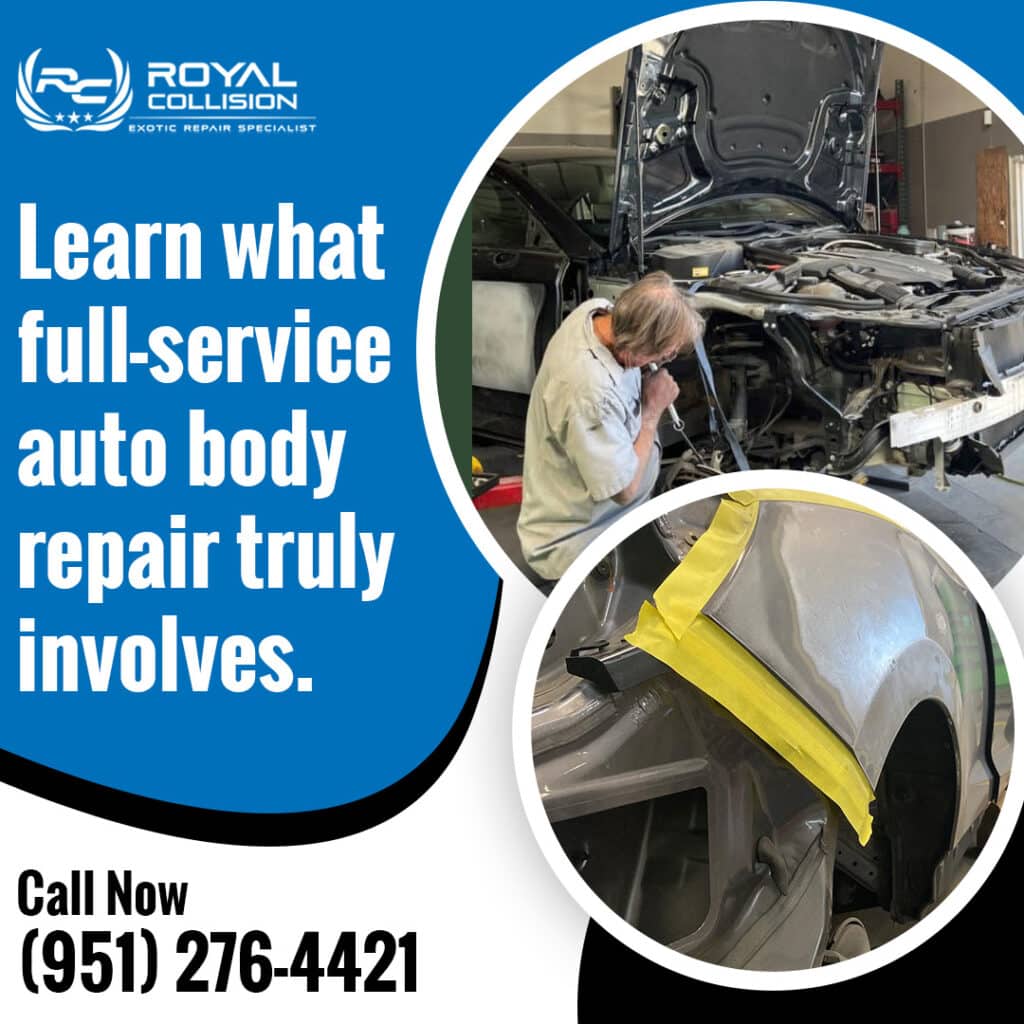
Royal Collision is a reputable auto body shop in Riverside, CA that has over a decade of experience. We help you sort out what your vehicle really needs after an accident. We work on later-model cars and performance vehicles that require accurate repairs, OEM parts, and documented steps. Our team coordinates paintless dent repair (PDR) as a sublet service when the damage is a true door ding with intact paint. We break down what a full-service auto body shop repairs beyond dents, what steps matter most, and what you should confirm before authorizing repairs.
Why Is Collision Repair More Complex on Today’s Vehicles?
Modern vehicles use high-strength steel, aluminum, sensors, and onboard computers that require precise, manufacturer-guided repairs after a collision. Auto body repair looked very different a decade ago. Once a technician straightened a panel and resprayed it, the job was done. That approach no longer applies to most vehicles on the road.
Later-model cars feature Advanced Driver Assistance Systems (ADAS), including collision detection, steering correction, and braking assistance. These rely on cameras and radar sensors at precise vehicle positions. When impact shifts those points, sensor accuracy is compromised.
Aluminum panels respond to heat and force differently from steel. Using incorrect repair methods creates a corrosion pathway beneath the surface. Airbag systems are calibrated to structural geometry. A frame deviation from factory tolerances changes how those systems respond.
| Features in Modern Vehicles | Impact on Repair Complexity |
| ADAS sensors (camera and radar) | Require recalibration after structural or bumper repair |
| Aluminum and mixed-material panels | Require dedicated tools and corrosion protection methods |
| Multiple airbag systems | Post-repair scan required to confirm readiness before delivery |
| Unibody construction | Frame measurement verifies alignment tolerances against factory specs |
Does a Full-Service Auto Body Shop Repair Frame Damage?
Yes. Restoring structural alignment requires manufacturer repair procedures and precision measuring equipment, not guesswork.
Frame damage rarely looks obvious from the outside. Your vehicle can appear undamaged while the underlying structure has shifted. That shift changes driving behavior, affects crash energy distribution, and can prevent safety systems from working as designed.
Frame Measurement and Straightening
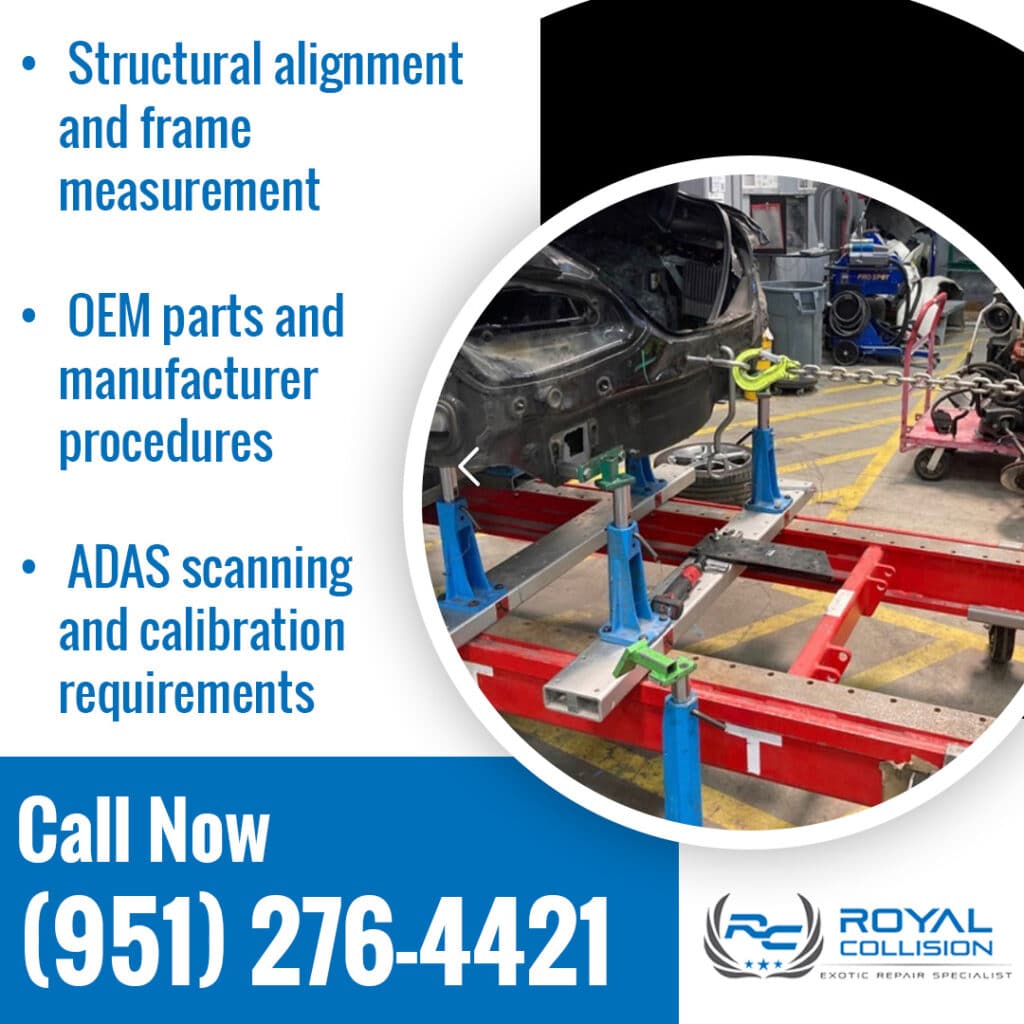
We use a Car-o-liner Car-o-matic frame measuring system to map every structural reference point against factory specifications. This tells us precisely what moved, how far, and what it takes to return it to manufacturer tolerances.
Straightening is performed on our Cheetah® frame rack. Controlled force is applied at precise points to restore geometry without stressing the surrounding structure. Manufacturer tolerances guide every correction, separating a structurally sound repair from one that only looks finished.
How Mixed Materials Affect the Structural Repair Process
Many later-model vehicles combine steel and aluminum in their body structure. Each material responds differently to heat, force, and welding. Using the wrong approach for either material can affect handling and compromise crash performance.
Post-repair diagnostic scans verify whether any fault codes were introduced during structural work. Structural replacements are performed using OEM parts whenever available and approved under the repair plan.
Why Do OEM Parts Matter in Professional Auto Body Repair Services?
OEM parts are engineered for the specific vehicle. They maintain crash safety ratings and sensor accuracy that aftermarket alternatives may not reliably match. Which parts go into your vehicle is one of the most consequential repair decisions. It is also a question most drivers never ask.
OEM bumper assemblies position sensors at the exact heights and angles needed for accurate readings. Parts made by outside suppliers are built to approximate those dimensions. A small variation in sensor placement can affect braking assistance timing or collision detection reliability.
| Repair Factor | OEM Parts | Aftermarket Parts |
| Crash test compatibility | Tested with the specific vehicle model | Not always tested for that application |
| Sensor fitment | Exact factory mounting position | May require manual adjustment |
| Airbag deployment | Calibrated to factory structural geometry | May alter deployment sequence |
| Warranty coverage | Manufacturer’s warranty applies | May conflict with vehicle warranty terms |
We prioritize OEM parts and follow manufacturer repair procedures for every vehicle we repair. In most cases, customers only pay their deductible for OEM parts and manufacturer-approved procedures, depending on their policy coverage. If your insurer pushes for alternative parts, we document what is required and advocate directly on your behalf.
What Safety Systems Need Attention After a Collision?
Advanced Driver Assistance Systems must be scanned, reset, and recalibrated following any structural, bumper, or windshield repair. This step gets skipped at many shops. Every vehicle we take in goes through a pre-repair diagnostic scan using Autel tools before any work begins. This records which fault codes existed before we touched anything, protecting both you and our team from any confusion over the origin of issues.
Pre-Scan, Post-Scan, and Calibration
Once all body, frame, and paint work is complete, we run a full post-repair scan. This confirms that no new diagnostic trouble codes were introduced and that all vehicle systems communicate as intended.
When ADAS recalibration is required, including camera realignment, radar target positioning, or sensor resets, this is handled through qualified sublet specialists. Calibration is matched to the specific make, model, and affected system.
Major automakers, working with NHTSA and IIHS, committed to making automatic emergency braking standard across new light vehicles beginning with the model year 2022. Most later-model vehicles on the road today carry at least one system that requires post-repair verification.
A post-repair scan confirms your safety systems are functioning. Without it, there is no confirmation either way.
Can a Shop Handle High-Strength Aluminum Body Panels?
Yes, provided the shop has the right tools and proper welding equipment for aluminum-specific repair methods. Aluminum appears on many newer vehicles in hoods, door skins, fenders, and structural panels. Its weight advantage makes it a manufacturer’s preference. It also requires a completely different repair approach from steel.
Steel and aluminum cannot share grinding wheels, dollies, or work surfaces during a repair. Steel particles transferred to aluminum cause galvanic corrosion. Aluminum welding requires different equipment and technique than steel work.
Our welding equipment includes Miller MIG welders and Electron Spot welders. Both are suited to the material demands of later-model vehicles. All repairs follow manufacturer procedures for the specific vehicle.
Aluminum repaired with the wrong method may look fine when it leaves. Corrosion from improper technique often appears well after the vehicle is back on the road. By then, the connection to the original repair is far less obvious. The right method, done once, is the only acceptable standard.
Why Is Professional Paint Refinishing About More Than Appearance?
Paint seals the metal from moisture and environmental exposure. It is corrosion protection. Restoring your vehicle’s appearance comes with it. Once body and structural work is complete, your vehicle moves to our cross-down draft paint booth. It supports consistent paint application and meets California’s air quality standards for automotive refinishing.
Color matching starts with a spectrometer camera reading your vehicle’s existing finish. The reading accounts for paint age and prior exposure before mixing. This produces a match across every repaired panel, not just a close approximation.
We refinish using the Sherwin-Williams automotive system throughout the process. Before reassembly, each painted surface goes through a denib and polish cycle and a color check. Your vehicle does not leave until the finish meets our standards.
Paint that does not seal the metal is not a finished repair. Corrosion starts at the gaps before it becomes visible, and it spreads.
Does Windshield and Glass Replacement Affect Your Vehicle’s Safety Features?
Yes. Windshields with forward-facing cameras require recalibration after replacement, not just new glass. Glass replacement is a direct service we provide. In later-model vehicles, the windshield carries more than laminated glass. Rain sensors, forward collision cameras, and driver monitoring components are mounted to or behind the glass assembly.
After installation, the adhesive must cure fully before the vehicle is driven. Driving on uncured adhesive compromises the windshield’s structural role during a roof crush event or airbag deployment. This is a safety requirement, not a scheduling detail.
When cameras are integrated into the windshield assembly, we coordinate recalibration as part of the service. Your vehicle is not returned with an unchecked system.
Do Auto Body Repair Shops Handle Mechanical Damage After a Collision?
Yes. Collision impact regularly damages suspension, steering, and cooling components that show no outward signs of damage. Any auto body repair shop worth choosing should inspect beyond the surface. A direct corner hit can leave a vehicle looking intact. The control arm, tie rod end, or wheel bearing behind that corner may still be bent or cracked. Driving on compromised suspension creates handling problems and stresses connected parts.
We include mechanical repairs as part of the collision repair process. Suspension components are assessed during the repair plan and replaced when needed. Alignment follows every frame repair. Structural corrections change the reference geometry that wheel alignment depends on.
Cooling system components in the path of impact are inspected and addressed. Undetected cooling damage leads to engine problems later. Those repairs cost considerably more than catching the issue during the original job.
A repair covering only the visible exterior is an incomplete auto body repair job.
Who Does Your Repair Shop Actually Work For?
A shop with no insurer-directed program agreements works on your behalf, not the insurer’s. Some shops hold Direct Repair Program (DRP) agreements with insurance carriers. Under those arrangements, cost controls set by the insurer influence which parts get approved and which repair procedures move forward.
Royal Collision carries no DRP agreements. We work with all major insurance carriers, but repair decisions follow manufacturer procedures, not insurer cost schedules. That distinction matters when your vehicle’s safety is at stake.
Before your car arrives at our body shop in Riverside, CA, we walk you through the insurance process. We explain how your coverage applies to the damage, what parts will be used, and what to expect at every stage. Every repair is documented with photos, OEM procedure references, and insurer communications. We submit what is needed to justify the correct repair, and we follow through until the job is done right.
Our family-owned car accident repair shop has been providing professional auto body repair services in Riverside for 10 years. Owner Ryan is a second-generation technician with 15 years in the industry. Our body technician brings 30 years of hands-on experience, and our painter has 15 years in the craft. That depth shows in every repair.
What Questions Should You Ask Before Authorizing Auto Body Repair?
Before signing a repair order, ask every shop these questions and expect direct answers:
- Are OEM parts used on every job? Get it in writing.
- Is frame measurement documented before and after repairs? Request the printed report.
- Are pre-repair and post-repair scans standard on every vehicle? They should be.
- Who performs ADAS recalibration, and with what equipment? Confirm before work begins.
- What does the repair warranty cover, and for how long? Get full terms, not a summary.
Every auto body repair in Riverside, CA, at Royal Collision is backed by a Limited Lifetime Warranty covering all workmanship and paint for as long as you own the vehicle. Parts are covered under the manufacturer’s warranty. Any issue with our work after delivery is addressed directly, no runaround.
A qualified shop answers all of these questions without hesitation.
Frequently Asked Questions
Is there a warranty on auto body repairs, and who provides it?
The repair shop provides the warranty, not the insurer. We offer a Limited Lifetime Warranty on all workmanship and paint by Royal Collision for as long as you own the vehicle. Parts follow the manufacturer’s warranty terms.
Do I have to take my vehicle to the shop my insurer recommends?
No. California state law gives you the right to choose any licensed collision repair facility. Your insurer cannot require you to use a specific shop.
What types of vehicles does the shop service?
We work on most later-model passenger vehicles. We do not take on medium to heavy-duty trucks, RVs, boats, or trailers.
Choosing Royal Collision for Complete Auto Body Repair in Riverside
A dent is what you may see after an accident. Everything behind it, including structural geometry, sensor accuracy, safety system status, and paint integrity, determines whether your vehicle is genuinely road-ready after a collision.
Full-service repair at our car body shop covers the full scope: structural restoration, mechanical inspection, ADAS verification, glass integration, and factory-quality refinishing. Every affected system is addressed, not just the panel that shows the damage.
Royal Collision serves drivers throughout Riverside and the surrounding communities of Moreno Valley, Colton, San Bernardino, Loma Linda, Jurupa Valley, and Grand Terrace. If your vehicle has been in a collision, contact us before committing to any repair plan. Call us at (951) 276-4421 or email us at ryan@royalcollisionriverside.com to schedule an appointment. We will assess your vehicle thoroughly and make sure the repair covers everything it should.