A car that looks repaired is not always a car that is repaired. That gap between appearance and actual condition is where driver safety lives.
Every vehicle carries the specifications it was built to meet. Structural tolerances, safety system calibrations, and manufacturer repair procedures all exist to protect the people inside. Royal Collision, our family-owned shop, has spent more than a decade returning vehicles to those exact specifications.
Quality collision repair means restoring your vehicle to the structural and safety standards it was built to meet, not just its pre-accident appearance. We explain what these standards require and what to ask before any repair work is authorized.
What Does Quality Collision Repair Mean Today?
A proper repair achieves three things. It restores the vehicle’s structure to factory tolerances. It returns all safety systems to full operational status. Its OEM repair procedures define how each part of that system must be restored.
A repair that misses any of those criteria may look complete without being complete. The quality of collision repair is not measured by how a vehicle looks upon delivery. It is measured by whether it will protect you the next time it needs to.
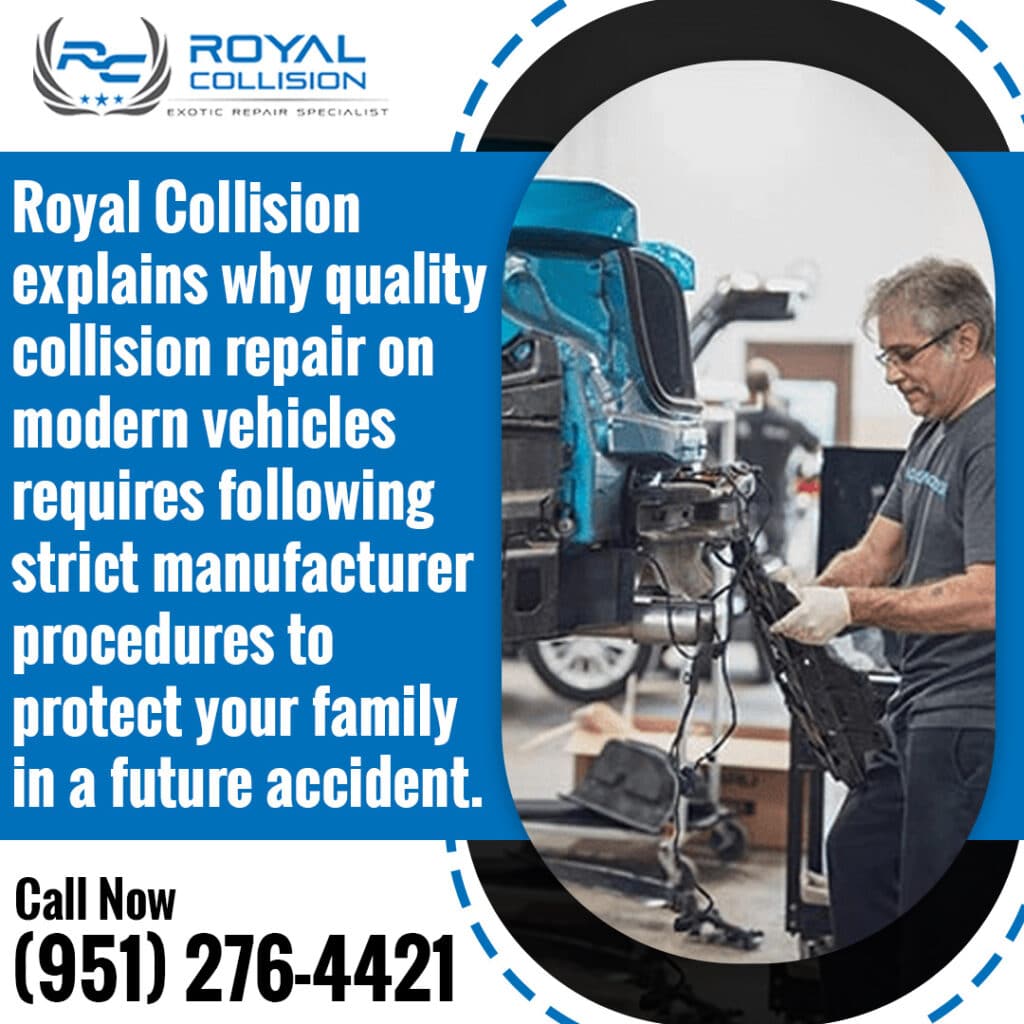
Modern vehicles operate as integrated systems. Each structural section, sensor mounting point, and engineered crumple path works within a crash-tested design. OEM repair procedures define how each part of that system must be restored. Skipping or substituting any step changes the outcome for everyone in that vehicle.
Why Today’s Vehicles Require More Precise Repair Methods
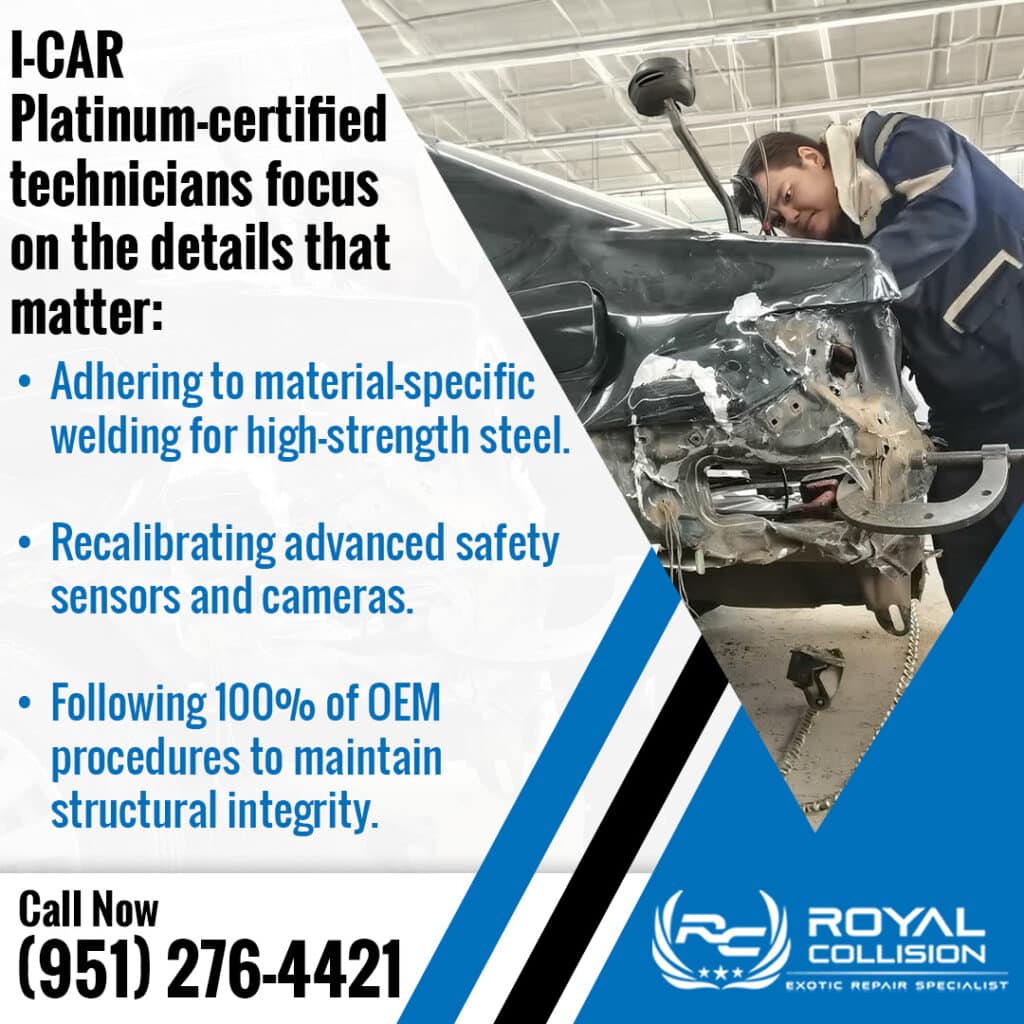
Current vehicle construction uses advanced material grades in structural sections: boron steel, high-strength aluminum alloys, and ultra-high-strength steel. Each requires specific welding methods. The wrong technique weakens the material rather than restoring it.
Most newer vehicles also carry advanced driver assistance systems. Cameras, radar units, and lane detection sensors are mounted directly to structural and body components. When those components shift in a collision, the systems attached to them can lose calibration without producing any visible warning.
Why OEM Standards Are the Foundation of a Proper Repair
OEM stands for Original Equipment Manufacturer. OEM collision repair follows the procedures, parts, and materials the vehicle’s manufacturer specified when designing and crash-testing the car.
OEM procedures define every repair operation. The correct weld type is specified for each material. Approved cut locations are defined for each structural section. Parts are verified to fit and function on that specific vehicle model.
OEM procedures are not a premium option. They are the minimum standard for returning a vehicle to its pre-collision structural and safety condition.
These procedures protect crumple zones, airbag deployment corridors, and sensor mounting tolerances. Repairs that deviate from manufacturer guidance alter those protections without any visible sign.
The Insurance Institute for Highway Safety documents this through ongoing research. Structural repair quality, including the method used and the parts installed, directly affects occupant protection in subsequent collisions.
OEM Parts vs. Aftermarket Parts: What Goes Back on Your Vehicle
The parts installed after a collision affect the outcome as directly as the repair method itself.
| Feature | OEM Parts | Aftermarket Parts | Why It Matters |
| Manufacturer | Vehicle’s original maker | Third-party producers | For design compatibility |
| Crash Testing | Vehicle-specific certification | Some match OEM performance when tested | Preserves crumple zones and safety cage integrity |
| Fitment | Exact factory specifications | Certified ones replicate OEM fit | Maintains structural load paths, sensor alignment |
| Warranty | Full vehicle manufacturer coverage | Supplier-specific, varies | Supports repair quality accountability |
OEM auto body repair installs components built to the vehicle’s exact original specifications. Aftermarket parts serve multiple vehicle applications and may differ in material grade, dimensional tolerance, and load performance. Some insurers default to aftermarket parts to reduce claim costs. Before authorizing any repair, confirm in writing what parts will be installed.
What Professional Collision Repair Looks Like in Practice
Professional collision repair follows a defined sequence. It starts with disassembly before any repair plan exists. Removing panels reveals what the collision actually did beneath the surface. That picture drives every decision that follows.
The repair plan is written after disassembly, not before it. The repair timeline is confirmed after parts are ordered, not at intake.
Technician skill shapes the outcome at every stage. Welding advanced steel grades requires material-specific training and the right equipment for each material type. Working with aluminum panels requires separate procedures to prevent cross-contamination with steel. Our technicians at Royal Collision hold individual I-CAR Platinum certifications. This is the highest technician-level credential in the industry. It is earned through ongoing training in manufacturer repair procedures and material-specific methods.
Why Repair Planning Requires Disassembly First
A repair plan written before disassembly works from incomplete information. Structural fractures, wiring faults, and compromised suspension geometry regularly hide behind panels that look undamaged from the outside.
Blueprinting, the full documentation of all damage before any work begins, creates an accurate record for the repair and for insurance documentation. Without it, undiscovered damage surfaces mid-job, triggering supplement requests that pause insurer approvals and slow the timeline.
What “Certified Collision Repair” Actually Tells You
The term certified collision repair is used in different ways across the industry. It may refer to a manufacturer program, technician training, or general marketing language. These meanings are not the same.
At Royal Collision, we make a clear distinction between shop certifications and technician credentials. The person performing the repair holds the training, not just the business name.
Our technicians hold I-CAR Platinum status, which reflects ongoing training in OEM procedures and material-specific repair methods. When you evaluate a repair shop, we recommend asking who will work on your vehicle and what standards they follow, not just what labels are promoted.
Key Steps in the Collision Repair Process
Knowing each step helps you evaluate whether your vehicle received proper care. A structured process is what separates quality collision repair from incomplete work.
Step 1: Protection, Disassembly, and Pre-Repair Scan
We begin by preparing and protecting your vehicle. Floor mats, seat covers, and door areas are secured before disassembly starts. As panels are removed, we uncover hidden damage not listed in the initial estimate. We then perform a pre-repair scan using our Autel diagnostic tools. This identifies fault codes in airbag systems, ADAS components, and other affected areas before repairs begin.
Step 2: Structural and Frame Correction
When structural damage is present, we restore factory dimensions using our Cheetah® frame rack and Car-o-liner measuring system. Welding is completed using equipment matched to each material type. Measurements are verified throughout the process to maintain proper alignment and structural strength.
Step 3: OEM Parts Installation
We install OEM parts based on manufacturer specifications. Each component is checked for fit and alignment before refinishing begins. Proper fitment helps maintain structural load paths and supports safe performance in future collisions.
Step 4: Paint Matching and Refinishing
Our spectrometer camera reads your vehicle’s original finish and creates an accurate color match. Using Sherwin-Williams refinishing systems, we apply paint in a controlled booth to produce a consistent finish across repaired panels.
Step 5: Post-Repair Scan and Calibration
After repairs, we complete a post-repair scan to confirm all systems are functioning correctly. ADAS calibration is coordinated when required. No vehicle is returned without verifying that safety systems respond as intended.
How Insurance Decisions Affect What Your Vehicle Receives
When an insurer approves a damage estimate, they are approving a cost, not a repair standard. In many cases, cost-focused programs may influence parts selection or limit steps not clearly listed in the original estimate.
During a proper repair, additional damage is often found after disassembly. These findings are submitted as supplements with full documentation. At Royal Collision, we handle this process on your behalf and advocate for OEM collision repair procedures whenever required. About 95% of our customers pay only their deductible, even when proper repairs are completed.
California law gives you the right to choose your repair facility. No insurer can require you to use a specific shop. The facility recommended by your insurer may have cost agreements in place. The shop you select works for you and your vehicle, not the insurer.
Signs Your Vehicle Was Repaired Correctly
Check these areas before accepting your vehicle after repairs. These indicators help confirm whether collision repair was completed properly.
- Body alignment: Gaps between doors, hood, fenders, and trunk should be even on both sides. Uneven spacing may point to structural or fitment issues.
- Dashboard indicators: After repairs, no new warning lights should appear. Active alerts may indicate unresolved fault codes or missing system calibration.
- Road behavior: On a straight road, your vehicle should track evenly without steering correction. Pulling or vibration can signal alignment or suspension issues.
- Refinish quality: In natural light, repaired panels should match the surrounding areas in color and texture. Look for any visible transitions or inconsistencies.
Address concerns with us before accepting your vehicle.
Why Post-Repair Inspections Matter
An independent post-repair inspection verifies that repairs meet manufacturer standards. It checks structural accuracy, confirms safety system operation, and reviews installed parts against documentation. This added step helps protect you and supports your investment in professional collision repair.
Choosing a Collision Repair Shop in Riverside, CA
A shop worth choosing follows OEM procedures, documents each step, and communicates clearly with both you and your insurer. These are basic expectations in collision repair.
Royal Collision manages insurance communication, supplements, and parts approvals from the initial estimate through final delivery. In addition to collision repair, we provide glass replacement and coordinate paintless dent repair when appropriate. For reliable collision repair in Riverside, CA, we focus on proper repairs that support your vehicle’s safety and performance, not cost-driven shortcuts.
Questions to Ask Before Authorizing Any Work
- What parts will be installed, OEM or aftermarket?
- Will a pre-repair scan be completed after disassembly?
- How are ADAS systems checked and recalibrated?
- How are insurance supplements handled?
- When is the repair timeline confirmed?
- What does the final inspection include?
Clear, direct answers to these questions reflect a repair process built on transparency.
Why Repair Quality Matters Beyond the Current Damage
The work done on your vehicle today affects how it performs in the next collision. A repair built to factory tolerances preserves the crash energy management your vehicle was designed around. A repair that falls short can reduce that protection, even where nothing is visible.
AAA research confirms that ADAS sensors require professional recalibration after collision repairs to function as designed. Incomplete calibration reduces system effectiveness in real driving situations. That is the full value of quality collision repair: a vehicle that is not just road-ready in appearance, but genuinely is.
The Repair That Holds When It Has To
A proper collision repair is not defined by how it looks at pickup. It is defined by how it performs the next time your vehicle needs to protect you.
Royal Collision follows OEM procedures and uses OEM parts for all our repairs. Every job is fully documented. We handle the insurance process for every customer from first supplement to final approval. And every repair is backed by our Limited Lifetime Warranty, valid for as long as you own the vehicle.
If your vehicle has been in a collision, call us at (951) 276-4421 or send us an email at ryan@royalcollisionriverside.com. We will handle the rest with quality collision repair Riverside residents can rely on.