A serious crash changes your vehicle in ways that are not always visible from the outside. Impact forces travel through the frame, airbag circuits activate, and safety sensors shift from their calibrated positions, all while the exterior may show only moderate damage. Getting your car back to the condition it was built for takes a structured, step-by-step process that goes well beyond cosmetic fixes.
Royal Collision has experience spanning a decade, providing collision repair in Riverside, CA. High-speed accidents on the 91, 60, and I-215 are among the most common scenarios we see. Crashes that compress frame sections may trigger safety systems while leaving surfaces that look only lightly damaged. Knowing what a proper repair actually involves helps you ask the right questions and understand what collision repair you need. We explain the full process we follow for collision repair, from the first diagnostic scan to your vehicle’s final delivery.
What Qualifies as a High-Impact Collision?
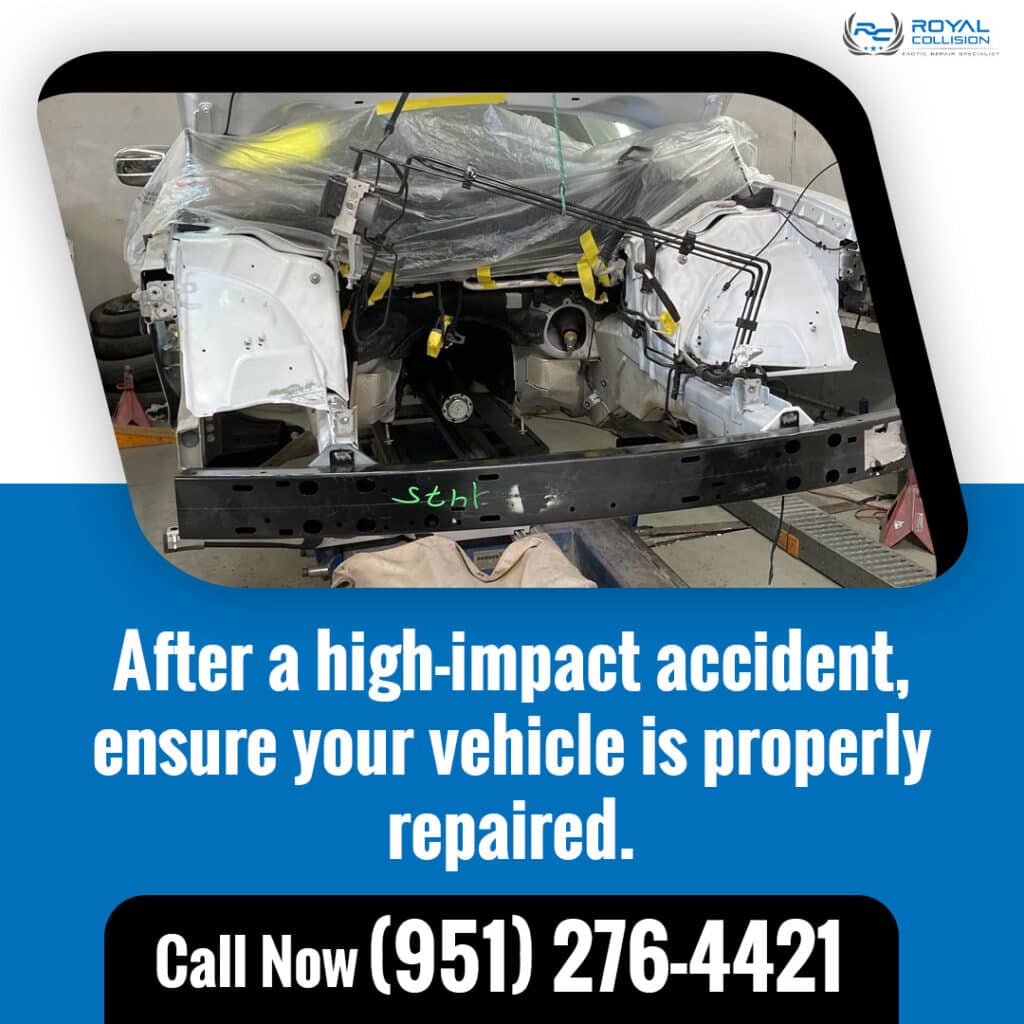
A high-impact collision is any crash that transfers enough force to compromise your vehicle’s structural geometry, frame, restraint systems, or safety technology. Common examples include freeway rear-end crashes, T-bone intersections, and side-impact events. Modern vehicles use unibody construction; the body and frame form one integrated structure. Crash energy entering at one point disperses through that entire structure. A rear-quarter impact can buckle a frame rail near the center of the vehicle. A frontal crash can shift the firewall inward.
This matters because surface damage is a poor guide to the actual repair scope. A relatively intact exterior can sit above displaced frame rails, shifted sensor mounts, and deactivated restraint circuits.
According to the National Highway Traffic Safety Administration, more than 2.3 million people were injured in U.S. motor vehicle crashes in 2022. Auto body collision repair after a high-impact event must begin with diagnostics and full disassembly, not visual assessments from the outside.
Why Major Collision Repair Is a Different Process Entirely
Major collision repair addresses structural geometry, electronic systems, and safety component function, not just visible panels. Minor repairs stay at the surface. High-impact damage works deeper. It alters frame dimensions, affects how restraint systems are wired, and shifts sensor positions that keep driver assistance features functioning correctly.
Modern vehicles are built with high-strength steel and engineered crumple zones. These design features manage crash energy in predictable ways, absorbing impact force before it reaches the occupant compartment. When repairs miss factory tolerances, even slightly, that energy management no longer performs as designed. The vehicle may drive normally. Its ability to protect occupants in a future crash, however, is already compromised.
This is why major collision repair at Royal Collision follows a documented, sequential process. Each stage depends on the accuracy of the one before it. No stage can be shortcut without affecting the integrity of everything that follows. We follow OEM repair procedures and manufacturer-published specifications to align repairs with the standards the vehicle was originally engineered to meet.
Step 1: Pre-Repair Scanning and Structural Assessment
Collision repair begins with a complete electronic pre-scan and full disassembly before any structural work starts. The first tool we use is an Autel diagnostic scanner. It reads all active fault codes across every vehicle system, identifying which circuits were triggered in the crash, which airbag sensors registered impact, and where electronic faults exist with no visible signs from the outside. Damage found here gets written into the repair plan. Any faults missed become problems after delivery, so we are meticulous in assessment.
Before disassembly begins, we prewash the vehicle and protect floors, seats, and door jambs. Full disassembly then reveals what surface inspection cannot show: buckled frame rails, compressed reinforcement bars, and shifted component mounts that are invisible from outside panels.
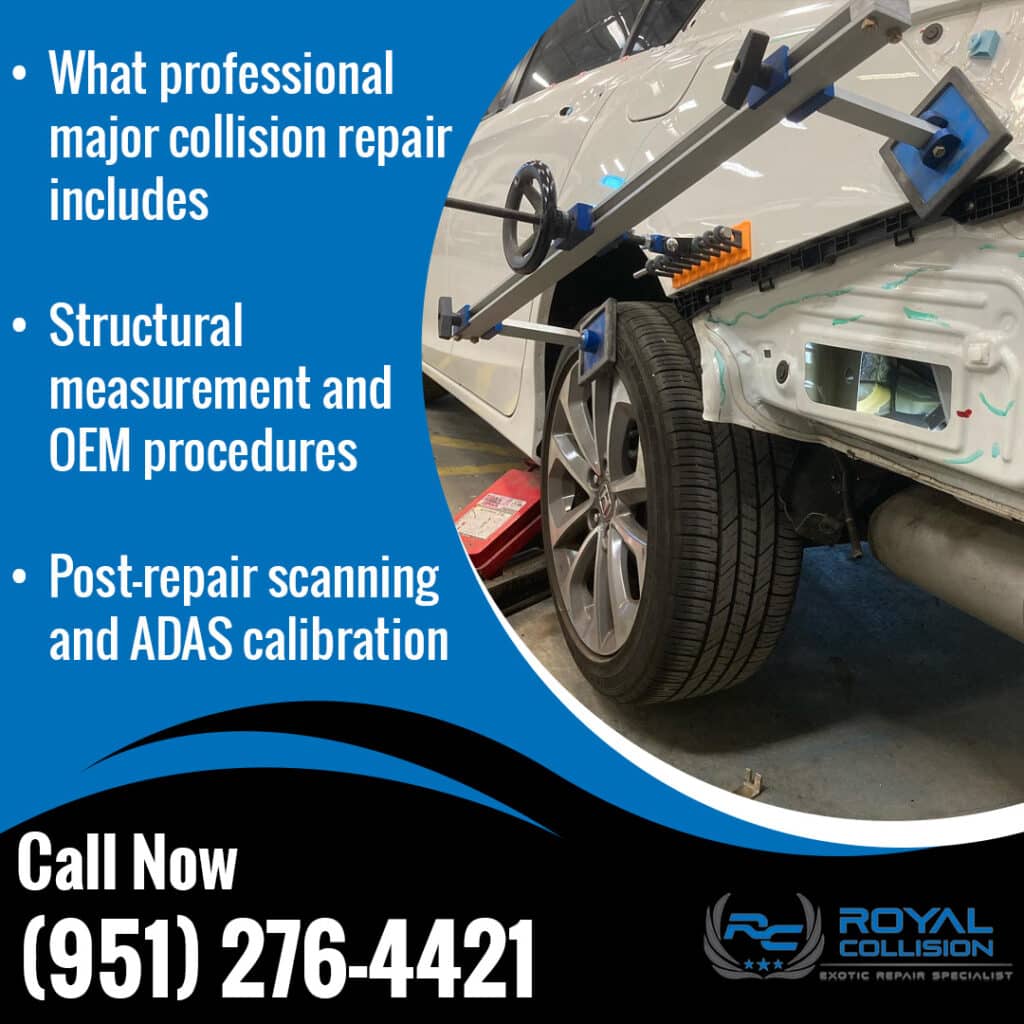
Frame measurement follows using our Car-O-Liner Car-O-Matic system. This computerized equipment maps actual vehicle dimensions against manufacturer specifications to the millimeter. All findings are photographed and paired with OEM repair procedures before we submit the complete package to your insurance company.
Our collision experts of Riverside at Royal Collision do not write repair plans from the outside. We write them only after disassembly confirms the full scope of damage.
Step 2: Frame Correction and Structural Restoration
Frame repair restores factory dimensions using controlled hydraulic pulling guided by real-time computerized measurement. We use our Cheetah® frame rack for this work. Force is applied to damaged sections while the Car-O-Liner system monitors dimensional change continuously. The process stops when factory specifications are confirmed, not when the result looks close. Visual approximation is not an acceptable standard for structural repair.
Weld placement is equally important. OEM procedures specify exactly where welds belong on each vehicle model. Welds placed outside those locations create stress concentrations in the steel, changing how the structure responds in a future crash. Our body technician carries I-CAR Platinum certification and 30 years of structural repair experience. He performs this work to the manufacturer’s specifications on every joint.
A frame not corrected to factory tolerances no longer manages crash energy the way it was designed to. This is where we push back against insurance cost pressures. Structural accuracy is what a safe repair requires, not an optional upgrade.
Step 3: OEM Parts, Glass Replacement, and Mechanical Repairs
Parts replacement, glass, and mechanical repairs are completed in sequence before any vehicle moves to the paint stage. All replacement parts are verified for fitment against the vehicle before installation. Gaps, alignment, and mounting points are confirmed against OEM specifications. We use OEM parts exclusively, covering structural panels, reinforcement sections, and body components. We prioritize OEM parts for structural and safety-related repairs because they are manufactured to the vehicle maker’s specifications. Some aftermarket parts may be certified through programs such as CAPA, but part selection should always follow manufacturer repair procedures and safety requirements.
Glass replacement is addressed at this stage. Cracked windshields, damaged side windows, and broken rear glass from the crash are replaced here. Cracked glass left in place can affect ADAS camera function and reduce cabin structural integrity in a rollover. Both carry direct safety consequences.
Mechanical damage is inspected and repaired within the same sequence. Serious collisions regularly displace cooling components, engine mounts, suspension parts, and brake hardware. At Royal Collision, mechanical issues are resolved before refinishing begins. No vehicle reaches the paint stage with unresolved mechanical damage. Correcting it afterward means reopening a completed repair. That is not how we work.
Step 4: Paint Refinishing and Corrosion Protection
Refinishing protects structural repairs from corrosion and restores your vehicle’s factory surface appearance.
After bodywork is complete, bare metal and fresh welds require immediate priming and sealing. Exposed steel corrodes quickly. Southern California’s UV intensity and dry particulate environment accelerate surface breakdown year-round. Proper prep protects the structural work underneath, not just the surface above.
We use the Sherwin-Williams automotive refinishing system with a spectrometer camera for color matching. The camera reads your existing paint’s light spectrum and generates a precise formula. It accounts for natural aging and fading, producing a blend that holds up over time.
Paint is applied inside our cross-down draft booth. Controlled airflow keeps contaminants away from wet surfaces and produces an even coat across all repaired panels. After curing, each panel goes through a denibbing and polishing process before reassembly. The result meets factory finish standards.
Step 5: ADAS Recalibration and Post-Repair Scanning
After panel and structural repairs, every driver assistance system must be verified and recalibrated before the vehicle is returned.
Vehicles from approximately 2018 onward use cameras, radar units, and ultrasonic sensors to run their safety features: lane departure warnings, automatic emergency braking, blind spot monitoring, and adaptive cruise control. Each sensor mounts to a specific location. When that location shifts during a crash, sensor aim changes with it. A forward camera off by one degree may no longer judge lane position correctly. It may also miscalculate stopping distances. Neither error announces itself.
After repairs, we run a full post-repair scan using Autel tools to verify fault resolution across all systems. ADAS recalibration is then performed by our specialized sublet calibration partner using factory-specified target procedures. This step requires controlled environments and dedicated equipment that goes beyond general shop capability.
Our collision repair shop in Riverside documents both the pre-repair and post-repair scan results for every job. You receive a verifiable record confirming all systems were addressed, not assumed to be working.
Step 6: Final Inspection and Vehicle Delivery
Every vehicle goes through a documented multi-point inspection before we return it to you.
Our final inspection covers panel gap consistency, paint match, surface quality, and electronic system function after the post-scan. We also conduct a road test to confirm mechanical and handling performance. Interior protection used throughout the repair, including floor covers, seat covers, and door jamb tape, is removed. The vehicle receives a complete exterior and interior detail before delivery.
You receive a vehicle verified structurally, mechanically, electronically, and cosmetically. All repairs and paint carry our Limited Lifetime Warranty for as long as you own the vehicle. Parts carry the manufacturer’s warranty. Any workmanship issue that surfaces after delivery is addressed directly.
What Improper Collision Repair Actually Costs You
Substandard repairs reduce crash protection, disrupt safety system accuracy, and lower resale value, often with no visible warning signs.
A vehicle can drive normally after a poor repair. The problem appears in the next accident. Structural sections that are not restored to factory dimensions may alter how crash energy is managed in a future collision, which can affect occupant protection performance. Improper structural repairs can affect the positioning of crash sensors and related components. If those components are not restored to manufacturer specifications, restraint system performance in a future collision may be compromised.
Poor repairs follow your vehicle on paper as well. They appear in pre-purchase inspections and vehicle history documentation. Trade-in offers and resale value decline in ways that are difficult to reverse.
Choosing a facility that follows OEM procedures throughout is a decision about protection. It determines how your vehicle performs in the next accident, not just how it looks at pickup.
Choosing the Right Collision Repair Shop After a Serious Crash
When getting collision repair in Riverside, CA, these are the questions worth asking any shop before committing:
| Question | Why It Matters |
| Are OEM repair procedures followed throughout? | Manufacturer specs are what restore actual crash protection. |
| Is frame measurement documented before and after? | Confirms structure was corrected to spec, not approximated. |
| Are pre- and post-repair electronic scans performed? | Verifies all fault codes were found, resolved, and cleared. |
| Are OEM parts used on all structural and panel repairs? | Protects crumple zone performance and restraint system timing. |
| Is a lifetime warranty provided on repairs and paint? | Reflects genuine confidence in the quality of work. |
We answer yes to all of these. Royal Collision does not participate in Direct Repair Programs, so no insurer controls our repair decisions or parts selections. We handle insurance communication directly with your insurer. Our team submits repair documentation and OEM procedures and advocates for what your vehicle needs. That is what working for the customer means, from the first call through delivery.
Here is what our customer said in an online review: “I had a perfect experience at Royal Collision. I was in an accident and brought my SUV into Ryan and his team. The communication was above and beyond. My car came back better than new, just beautiful! This shop sets the standard. I highly recommend.” – Amy L.
Frequently Asked Questions
How long does major collision repair take?
Repair time depends on the structural damage scope, parts availability, and insurance approval timing. We do not give timelines before full disassembly and repair plan completion, because outside estimates are not reliable. Once the full scope is confirmed and parts are ordered, we provide a specific schedule and keep you updated throughout.
Can a vehicle be returned to its original safety standard after a serious crash?
Yes. When OEM procedures, factory-tolerance frame measurement, and OEM parts are used at every stage. Our team includes a body technician with I-CAR Platinum certification and 30 years of structural repair experience, and a painter with I-CAR Platinum certification and 15 years in refinishing. That combination of process and experience is what each stage of a proper repair requires.
Will my driver assistance features work correctly after the repair?
Driver assistance systems function correctly only after post-repair scanning confirms fault resolution and ADAS recalibration is completed to factory specifications. Repairs that skip scanning return a vehicle with safety systems in an unverified state. We document both scans for every job, so you have clear confirmation before taking delivery.
Restoring What a Serious Crash Takes Away
High-impact collision repair is a technical, documented sequence: structural assessment, frame correction, OEM parts and glass replacement, mechanical repairs, paint refinishing, ADAS recalibration, and verified delivery. Each stage serves a specific purpose. None can be skipped without consequences that follow the vehicle forward.
If your car was in a serious crash on Riverside’s roads or freeways, get a professional inspection before driving further than needed. Contact Royal Collision at (951) 276-4421 or ryan@royalcollisionriverside.com. Our I-CAR Platinum-certified technicians deliver the quality you expect from certified collision repair services. We document the full damage and restore your vehicle to the standard it was built to meet.