Vehicle repairs involve more than replacing damaged panels or repainting surfaces. Modern vehicles rely on structural accuracy, electronic safety systems, and proper calibration after a collision. Even when repairs appear complete, important checks still need to be performed before the vehicle safely returns to the road.
A post-repair road test helps confirm that steering, braking, suspension, alignment, and driver-assistance systems respond correctly under normal driving conditions. It can also reveal hidden concerns that may not appear during a visual inspection. These final checks are an important part of quality collision repair and help confirm your vehicle performs safely before delivery.
At Royal Collision in Riverside, California, we include post-repair road testing as part of our repair process for later-model collision-damaged vehicles. Our team follows OEM repair procedures, performs post-repair scans, and evaluates vehicle performance before returning the vehicle to you.
Why Final Checks Matter After a Collision Repair
Modern Vehicles Depend on Precise Repairs
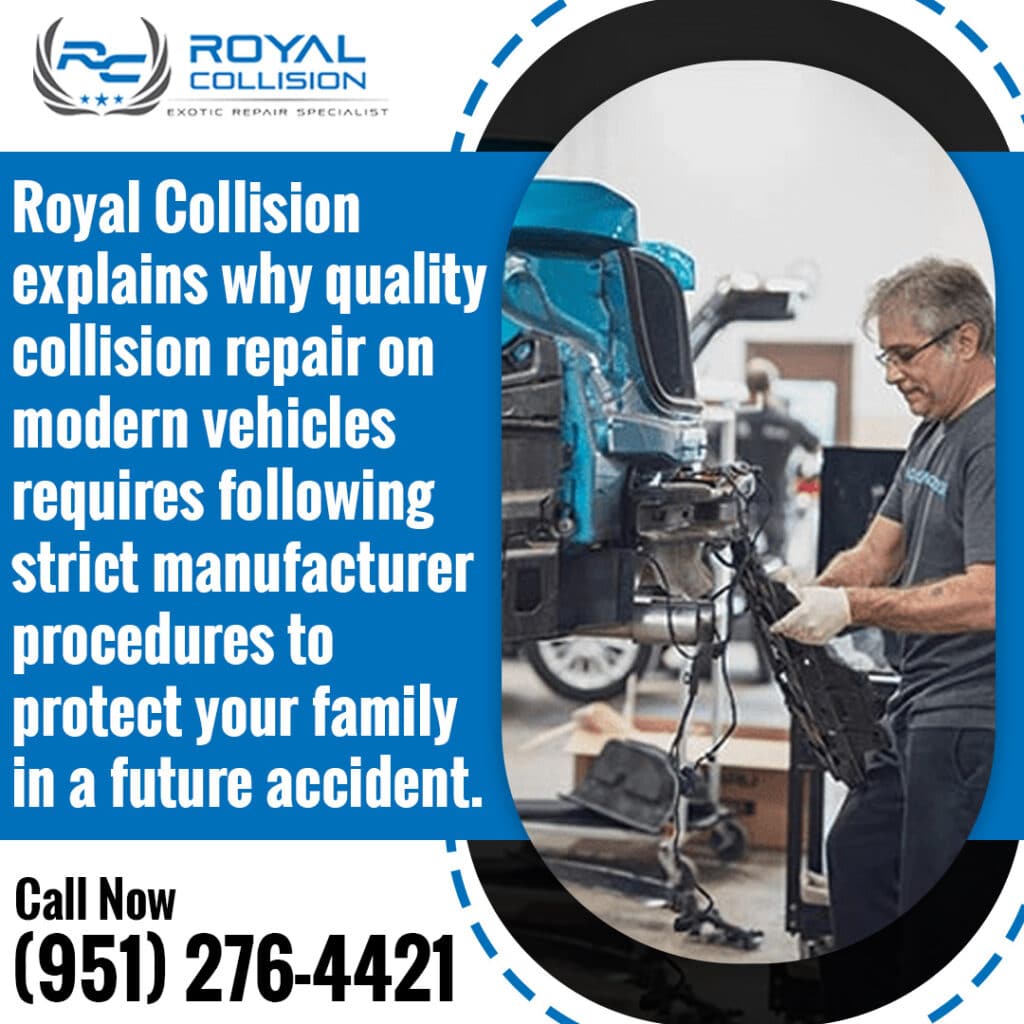
Today’s vehicles are built with tight structural tolerances. Advanced Driver Assistance Systems (ADAS) use sensors, cameras, and radar that must be precisely positioned to function correctly. A collision can shift these components without visibly cracking them. A structural repair that is off by even a small margin can affect how the vehicle performs and how its safety systems respond.
Cosmetic Repairs Alone Do Not Confirm Vehicle Safety
Your repaired vehicle can look correct while carrying hidden problems. Frame misalignment, suspension wear, or steering irregularities may not appear during a visual walkthrough. A final road test is the step that reveals whether your vehicle drives correctly, not just looks correct. Without it, safety-critical issues can reach you undetected. These final checks also help confirm that safety systems and structural repairs were properly addressed.
What Happens Before the Post-Repair Road Test?
The road test is the final step in a structured process. Each stage before it directly shapes what the road test verifies.
Repair Planning and Insurance Documentation
Before your vehicle arrives, we walk you through the insurance process: how coverage applies to repairs, what parts your vehicle should receive, and what to expect. Once the vehicle is in, we start with a prewash and apply floor mat covers, seat covers, and door jamb tape to protect the interior. We photograph all visible damage before disassembly begins. After the pre-scan is complete, we write the formal repair plan and submit it with OEM procedure documentation and supporting photos. Parts are ordered only after you review and approve. At Royal Collision, each step in the process helps support OEM collision repair procedures based on what your vehicle actually needs.
Pre-Scan and Post-Scan Diagnostics
We use Autel diagnostic tools for both the pre-scan and post-scan. The pre-scan logs any trouble codes present before structural work starts. This creates a clean baseline. The post-scan runs after all repairs are complete to catch any diagnostic trouble codes (DTCs) that appeared during the process. We coordinate any required ADAS calibration before the vehicle moves to the road test.
Structural and Mechanical Repairs
Once parts are ordered and the repair plan is approved, our technicians begin the physical work. We use the Cheetah® frame rack and the Car-o-liner Car-o-matic measuring system to restore structural geometry. We use only OEM parts for all replacement components as part of our OEM auto body repair process. We do not reassemble anything until fitment and dimensional accuracy are confirmed.
What Technicians Look for During a Post-Repair Road Test
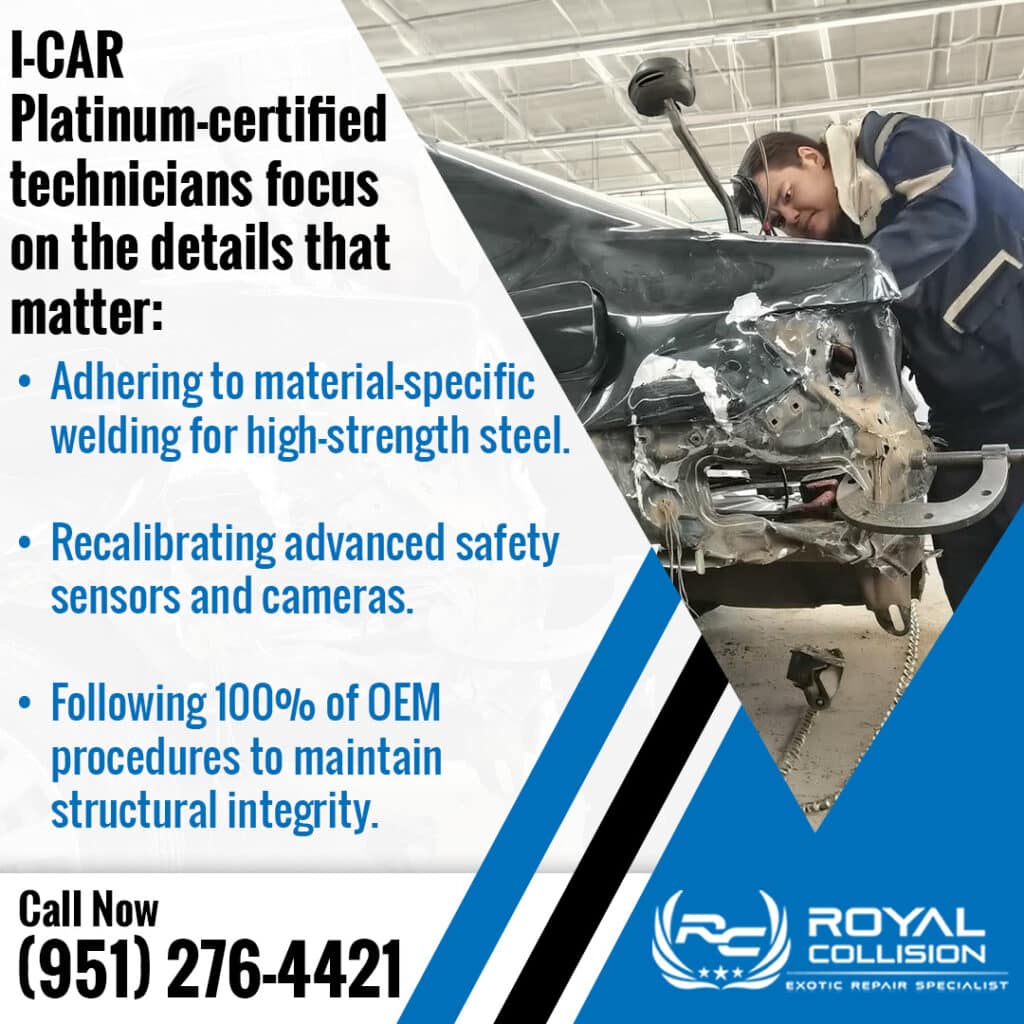
This is the practical core of the process. At Royal Collision, our I-CAR Platinum-certified body and paint technicians evaluate real-world vehicle behavior during every certified collision repair road test. Every check here answers a question that a static visual inspection cannot.
Steering Response and Vehicle Tracking
We drive the vehicle at varied speeds to assess how it tracks. A properly repaired vehicle drives straight without pulling in either direction. The steering wheel should self-center smoothly after turns. If your vehicle drifts or the wheel sits off-center, we address wheel alignment or suspension geometry before delivery.
Suspension and Ride Quality
Road vibrations, unusual bounce, or rough handling point to suspension components that were not fully addressed. The road test applies stress to these parts that a static inspection cannot replicate. Any unusual feedback through the seat or steering wheel gets investigated before we clear the vehicle.
Brake Performance Evaluation
We check brakes for consistent pedal feel, response time, and stopping power. Collision damage can affect brake lines, calipers, or rotors without visible signs. We confirm normal brake response and check for any pulsation or directional pull during stops. This matters if you commute on Riverside’s busy freeways and depend on responsive braking.
ADAS and Safety Feature Verification
You may assume your safety systems are fine once the bodywork looks correct. ADAS features like forward collision warning, lane-keep assist, and blind-spot monitoring need precise calibration to function correctly. After an impact, sensors can shift even without visible surrounding damage. We verify that all active safety systems are performing before returning your vehicle.
Engine, Transmission, and Mechanical Operation
The road test covers general mechanical function as well. We listen for unusual engine sounds, evaluate shift quality, and confirm that no warning lights appear under normal operation. We verify all mechanical repairs completed during the job before clearing the vehicle for delivery.
The table below summarizes what each road test check evaluates and what can go wrong if any step is skipped.
| Road Test Check | What It Evaluates | If Skipped or Missed |
| Steering tracking | Alignment and frame geometry | Vehicle pulls, unsafe handling |
| Suspension response | Impact damage to shocks, struts, and control arms | Vibrations, unstable ride |
| Brake performance | Caliper, rotor, and line integrity | Reduced stopping power |
| ADAS calibration | Sensor positioning and software accuracy | Safety features fail in emergencies |
| Post-scan diagnostics | Electronic fault codes across all modules | Hidden codes affect safety systems |
| Engine/transmission check | Mechanical function after collision repair | Noise, warning lights, or failures post-delivery |
The Importance of Post-Repair Scans and Calibrations
Why Modern Vehicles Require Electronic Verification
After a collision, your vehicle can carry electronic fault codes that never trigger a visible warning light at rest. Control modules for airbags, stability control, and ABS can log codes from the impact itself. These codes may not cause symptoms until your vehicle is driven under normal conditions. Running that post-scan identifies which systems logged codes during the collision, including those showing no visible physical damage.
Royal Collision runs a post-scan on every completed repair. The National Highway Traffic Safety Administration (NHTSA) recognizes the increasing adoption of advanced driver-assistance systems (ADAS) in modern vehicles and highlights the importance of proper repair procedures and calibration to help ensure these systems function as designed after a collision.
Calibration Helps Restore Safety Features
ADAS calibration after collision work is a manufacturer’s requirement for many vehicles. A system that appears active on the dashboard may not perform correctly in an emergency if calibration was skipped. We coordinate calibration as part of the repair process before the road test begins.
Insurance Institute for Highway Safety (IIHS) research shows that vehicles equipped with front crash prevention systems, including automatic emergency braking, experience significantly fewer rear-end crashes compared to similar vehicles without these systems. That benefit disappears if the system is not properly calibrated.
How Post-Repair Inspections Support Professional Collision Repair
Why Documentation Matters During Professional Collision Repair
Proper documentation plays an important role in professional collision repair and long-term vehicle safety. We keep detailed records at every stage: photos, repair plans, OEM procedure documentation, scan reports, and calibration records. If concerns arise later, that documentation provides a clear account of every step taken.
Our shop holds no Direct Repair Program agreements with any carrier. No insurer has a contract with us that shapes how your vehicle gets repaired. Our decisions come from what your vehicle needs, not a carrier’s cost targets. All repairs and paint are backed by a Limited Lifetime Warranty for as long as you own the vehicle. That warranty is ours, not the insurance company’s.
California’s Bureau of Automotive Repair (BAR) requires repair facilities to follow applicable industry standards and disclose repair practices in accordance with state regulations, and many OEM repair procedures are used as reference standards when performing collision repairs. That requirement aligns with what OEM documentation already demands. It also gives California drivers a clear regulatory basis for questioning whether a previous repair met that standard.
Questions Drivers Should Ask Before Picking Up Their Vehicle
These questions apply to any quality collision repair process, regardless of which shop you use:
- Were OEM parts used on my vehicle?
- Was the vehicle scanned for diagnostic trouble codes after repairs?
- Were any ADAS calibrations required, and were they completed?
- Was a road test performed before I was called for pickup?
These questions hold a shop accountable for the quality of the work, not just its appearance. The quality of our collision repairs is vouched for by customers. Here is what Matt Z., a customer, said in a Google review, “…If you care about your vehicle and want it repaired the right way, this is the place to go. They treat your car like it matters, and they treat you with respect. I would absolutely trust them again and would recommend them to anyone who wants quality work done right the first time.”
Common Problems a Final Road Test Can Catch
A thorough road test identifies issues before they follow you home:
- Steering wheel sitting off-center after structural repairs
- Suspension vibration from unresolved impact damage
- Brake pulsation from heat-warped rotors or caliper damage
- Wind noise from panel misalignment or improper sealing
- ADAS sensor faults are not visible on the dashboard at rest
- Warning lights triggered by electronic fault codes
- Tire wear patterns from unresolved alignment errors
- Drivetrain noise from components disturbed during repairs
Finding these before delivery is far safer than discovering them on your morning commute.
Why Riverside Drivers Should Pay Attention to Repair Quality
You depend on your vehicle every day in Riverside. The 91 freeway, I-215, and the 60 connect this region to Los Angeles, San Bernardino, and the Inland Empire. Stop-and-go commuter traffic puts constant stress on steering, brakes, and suspension. Systems not fully restored after a collision will surface that quickly. Drivers researching collision repair services in Riverside, CA, should pay close attention to repair procedures, final inspections, and post-repair testing standards.
If you are researching professional OEM auto body repair, repair quality is the right metric. How your vehicle handles under hard braking matters. How your safety systems respond in a near-miss matters. The cheapest option is not always the safest one.
Frequently Asked Questions
Is there a warranty on my collision repair?
Yes. All repairs and paint work are covered by a Limited Lifetime Warranty for as long as you own the vehicle. OEM parts carry the manufacturer’s warranty in addition to that coverage. If your insurer implies the repair is their responsibility once paid, know that warranties on repairs are always the shop’s responsibility, not the insurance company’s. We stand behind our work.
Does every vehicle need ADAS calibration after a collision?
Not always. It depends on the damage, the systems affected, and the manufacturer’s requirements for your specific vehicle. We evaluate this on every repair and coordinate calibration when it is needed.
When will I get a timeline for my repair?
We give you a repair timeline after the repair plan is written and parts are ordered. That is the point when we have a clear picture of what your vehicle needs and how long the work will take. We keep you informed throughout the process so there are no surprises before delivery.
Why Riverside Drivers Trust Royal Collision for Proper Post-Repair Inspections
A road test is not a formality. It is the step that confirms the repair was done right. We evaluate every system, from steering and brakes to ADAS electronics, under real driving conditions before returning your vehicle. After the road test clears, your vehicle goes through a full exterior and interior detail. Then we call you for pickup.
When you bring your vehicle to Royal Collision, every collision repair in Riverside, CA, follows this process without shortcuts. Call us at (951) 276-4421 or email us at ryan@royalcollisionriverside.com. We help you get back on the road safely, confidently, and with a better understanding of your vehicle’s needs.